
Ctrl K
1516–1578
**Parrasio Micheli** (also spelled Michiel; c. 1516–1578) was a Venetian Renaissance painter and draughtsman active in the Republic of Venice. The natural son of the Venetian aristocrat Salvador Michiel, he belonged to the patrician Michiel family but preferred the spelling “Micheli.”
Micheli received his early training in the workshop of Titian, with whom he maintained a close association; contemporary letters describe him as a product of the master’s studio, and he remained deeply influenced by Titian’s style throughout his career. He is documented in Rome before 1547 and later came under the influence of Paolo Veronese, who supplied drawings for some of his paintings.
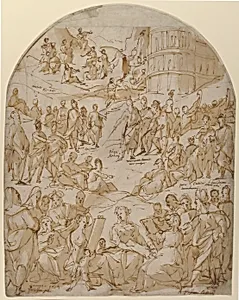
His documented output begins in the 1550s. Among his major works are the altarpiece of *San Lorenzo* (1550–51, Vicenza, San Lorenzo), the *Santi Marco e Vincenzo* (1555–56, now Gallerie dell’Accademia / Fondazione Cini), and the large canvas *Il doge Lorenzo Priuli, dieci senatori e le personificazioni della Fortuna e di Venezia* (1563, destroyed 1577; known from a preparatory drawing in Berlin). Later commissions include two altarpieces for Padua Cathedral (1565), the signed and dated *Autoritratto in adorazione del Cristo morto* (1573, Venice, San Giuseppe), and the *Allegoria della nascita di don Ferdinando di Spagna* (1575, Museo del Prado). Two signed paintings by him are preserved in the Prado, including *Pio V adorante il Cristo morto*.
Micheli also produced portraits of Venetian nobles (e.g., *Girolamo Zane*, Gallerie dell’Accademia) and mythological or allegorical subjects such as *An Allegory of Learning* (c. 1565, Metropolitan Museum of Art) and *Young Woman Playing a Lute* (c. 1570). He corresponded with Philip II of Spain in an unsuccessful attempt to secure royal patronage. His will, dated 17 April 1578, records his death in Venice later that month.
Though his oeuvre requires further scholarly clarification owing to later Veronese-inspired attributions, Micheli stands as a characteristic figure of mid-sixteenth-century Venetian painting, bridging the generations of Titian and Veronese while contributing to the decoration of major civic and religious spaces in Venice and the Veneto.