Ctrl K
1578–1630
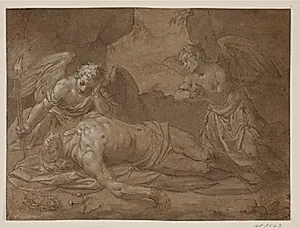
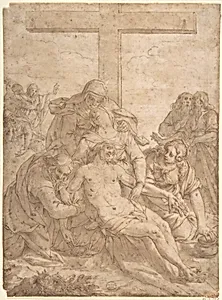
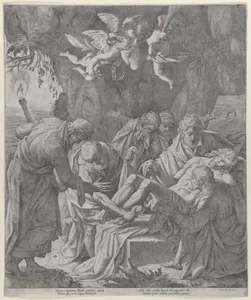
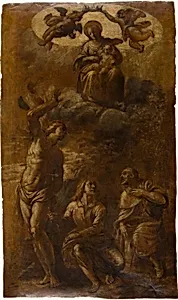
Pasquale Ottino (1578–1630), also known as Pasqualotto, was a Veronese painter who bridged the late Mannerist tradition of the Veneto and the emerging Baroque sensibility of early 17th-century Italy. Born and dying in Verona during the plague of 1630, Ottino developed a distinctive style that synthesized his early Mannerist training with the dramatic chiaroscuro and emotional intensity he encountered during his time in Rome. His works, often executed on fashionable slate or marble supports, demonstrate his mastery of religious subjects and his ability to adapt the innovations of Caravaggio and his followers to the Veronese tradition. Today his paintings are held in major collections including the Metropolitan Museum of Art, Galleria Borghese, and Art Institute of Chicago.
Born in Verona on September 26, 1578, Pasquale Ottino began his artistic training in the workshop of Felice Riccio (1542–1605), a well-established Veronese painter. Under Riccio's instruction, Ottino absorbed the late Mannerist culture of the Veneto region, characterized by elegant figures, complex compositions, and refined coloring.
He also worked with Felice Brusasorci, another important Veronese artist, further deepening his understanding of the local artistic tradition. These early experiences provided Ottino with a solid foundation in the Mannerist style that had dominated Venetian painting in the late 16th century.
Ottino arrived in Rome in 1609, entering a city transformed by Caravaggio's revolutionary naturalism and dramatic use of light and shadow. While in Rome, Ottino was exposed to the work of Giovanni Lanfranco and, more significantly, to the Roman pictorial culture of the 1620s shaped by Caravaggio's followers.
Particularly influential was Carlo Saraceni, through whom Ottino encountered Caravaggesque techniques mediated by a more refined sensibility. This Roman experience fundamentally altered Ottino's approach, as he learned to integrate the emotional drama and tenebrism of the Baroque with his Mannerist training, creating a distinctive synthesis.
Returning to Verona, Ottino established himself as one of the city's leading painters. He specialized in religious subjects, particularly Depositions, Passion scenes, and other dramatic moments from Christian narratives. His works from this period show the full integration of his Roman experiences with his Veronese heritage.
Ottino became particularly noted for paintings executed on slate or marble plates, a technique that was extremely popular between 1590 and 1630. Verona, along with Florence, was a major center for this practice, and Ottino's technical mastery made him a sought-after practitioner. The smooth, dark surface of slate enhanced the luminous quality of his colors and deepened his shadows, perfectly complementing his Caravaggesque style.
Artheon Research Team
Last updated: 2025-11-09
Biography length: ~487 words