Ctrl K
1883–1949
**Paul Kleinschmidt (1883–1949)** was a German painter and graphic artist associated with Expressionism, though he developed a highly personal style marked by vibrant color, thick impasto application, and a sensual, physical presence in his figures. Born in Bublitz, Pomerania (now Bobolice, Poland), he came from a family of artists and spent his early years traveling with a circus, experiences that later infused his work with themes of performance, nightlife, and exuberant femininity.
Kleinschmidt trained at the Berlin Academy from 1902, where his primary teacher was the history painter Anton von Werner; there he also encountered Lovis Corinth, whose influence proved formative. In 1904 he moved to the Munich Academy, studying under Peter Halm and Heinrich von Zügel, mastering lithography and engraving alongside painting. He participated in the Berlin Secession exhibitions of 1908 and 1911, forging connections within progressive artistic circles. His first solo show came in 1923 at Berlin’s Euphorion publishing house, followed by another at the Gurlitt Gallery in 1925.
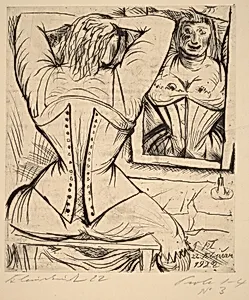
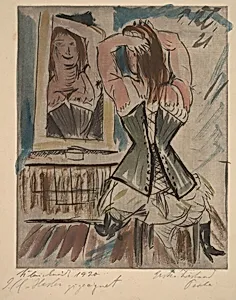
Kleinschmidt’s mature work focused on dazzling, modern women—barmaids, dancers, prostitutes, and circus performers—rendered with bold, direct brushwork and rich materiality. These scenes drew from 1920s Berlin nightlife and his circus childhood, often featuring erotic accessories and café or variety-show settings. His paintings achieved international recognition through patrons such as New York collector Erich Cohn, who facilitated U.S. exhibitions in the early 1930s. The Nazis condemned his art as degenerate, confiscating works for the 1937 Munich exhibition and banning him from painting in 1943.
Forced to relocate repeatedly, Kleinschmidt eventually settled in Bensheim, where many of his paintings were destroyed in a 1945 air raid. He died there in 1949. Today his distinctive voice within German Expressionism is preserved in museum collections worldwide, including eight works held by this virtual museum, underscoring his enduring appeal for his unorthodox celebration of color, texture, and the vitality of the human form.
All 5 artworks loaded