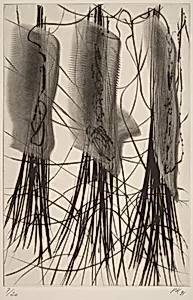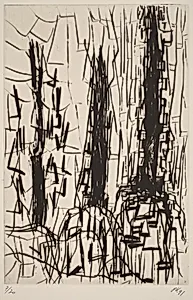
Per Kirkeby (1938–2018) was a Danish artist of exceptional versatility whose career encompassed painting, sculpture, printmaking, film, and writing, establishing him as one of the most significant European artists of the postwar era. Born in Copenhagen in 1938, Kirkeby studied geology at the University of Copenhagen and participated in scientific expeditions to Greenland before enrolling at the Experimental Art School in Copenhagen, a formative institution that placed him in contact with the international avant-garde currents of the 1960s, including Fluxus. This unusual dual formation — scientific fieldwork and artistic experimentation — left permanent traces in the richly layered, geologically inflected imagery of his mature painting.
Kirkeby's paintings are dense, mysterious, and deeply atmospheric. Working in oil with heavy impasto and complex layering, he built up surfaces that suggest simultaneously the strata of rock, the growth of vegetation, and the memory of landscape, history, and the body. His color is often dark and brooding, punctuated by sudden passages of vivid hue, and his compositions resist easy narrative reading while generating a powerful sense of accumulated meaning. He was associated with the broader movement of Neo-Expressionism that emerged in Europe and America in the late 1970s and 1980s, yet his work has an intellectual density that distinguishes it from the more gestural painters of that tendency.
Beyond painting, Kirkeby was celebrated for his monumental brick sculptures — large-scale architectural constructions inspired by Romanesque and Gothic forms that were installed in public spaces across Europe and America. His prints and bronzes extended his visual language into further media, while his extensive writings on art established him as a serious thinker and critic.
Kirkeby taught at the Städelschule in Frankfurt and exhibited widely in major international venues throughout his career. He died in Copenhagen in 2018, remembered as an artist of rare intellectual ambition and formal power whose work continues to be exhibited and studied by institutions around the world.


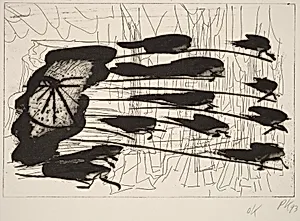
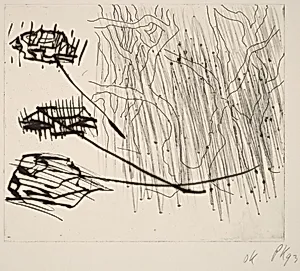
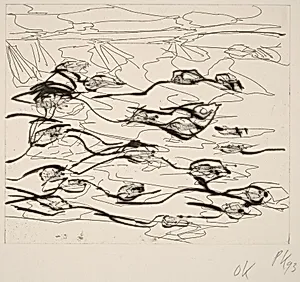
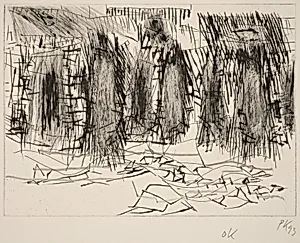
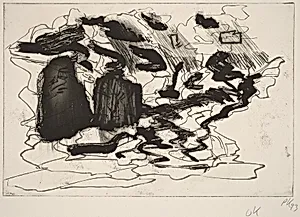

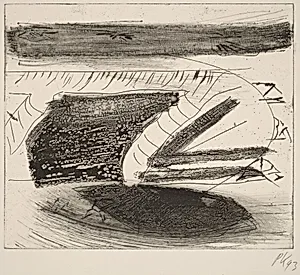
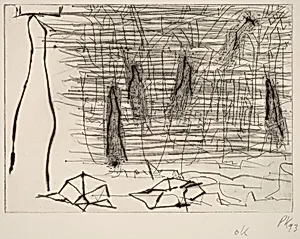

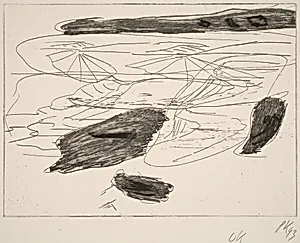
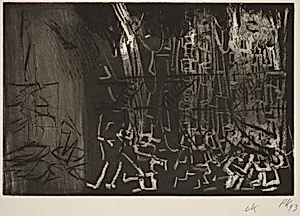
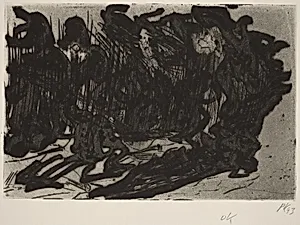
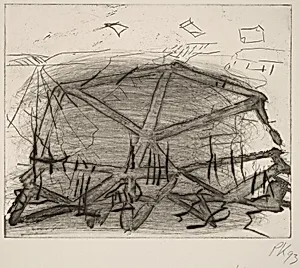
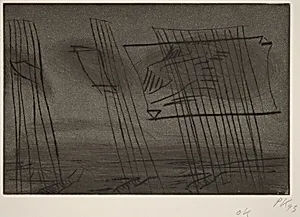
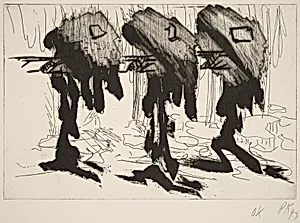
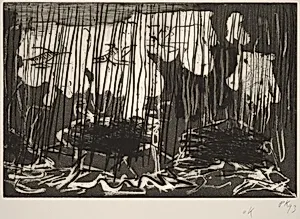
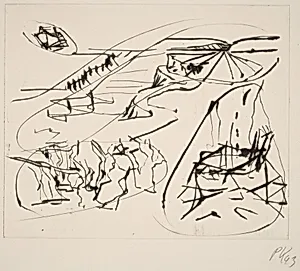
![Thoughts in the Sun [working proof 3]](https://images.artheonmuseum.org/nga/thumb/thoughts-in-the-sun-working-proof-3-nga-230388.webp)
![Thoughts in the Sun [working proof 4]](https://images.artheonmuseum.org/nga/thumb/thoughts-in-the-sun-working-proof-4-nga-230389.webp)