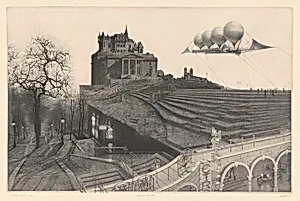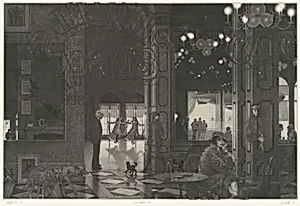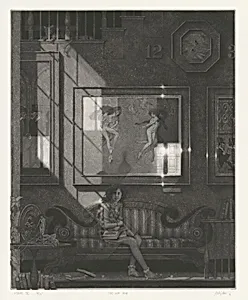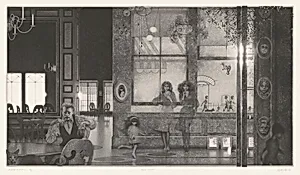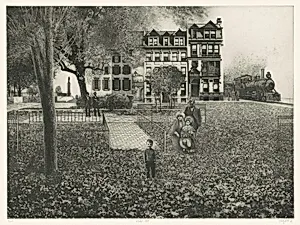
Peter Winslow Milton, born on April 2, 1930, in Lower Merion, Pennsylvania, moved with his family to Pittsfield, Massachusetts, in 1938. He attended the Darrow School, followed by two years at the Virginia Military Institute, before pursuing formal art training at Yale University School of Art and Architecture, where he studied under Josef Albers and earned his BFA in 1954 and MFA in 1961. Initially focused on painting influenced by Cézanne and later non-objective styles akin to Stuart Davis, Milton shifted toward sculpture and back to painting before discovering his deuteranopia colorblindness in 1959, prompting a decisive turn to black-and-white printmaking.)
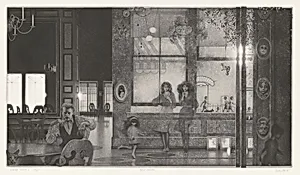
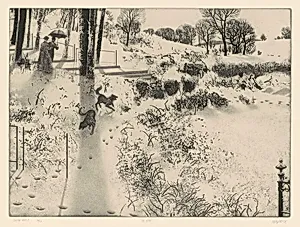
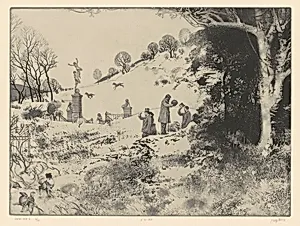
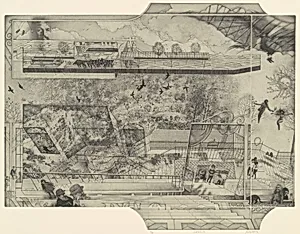
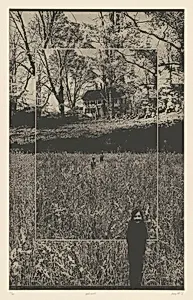
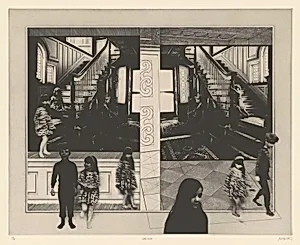
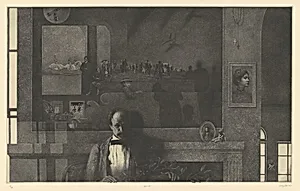
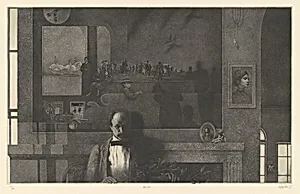
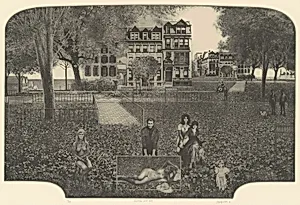
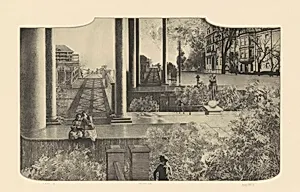
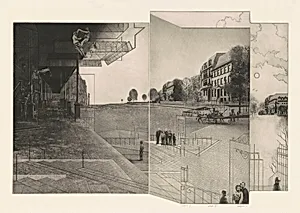
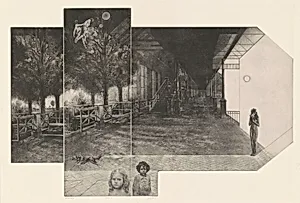
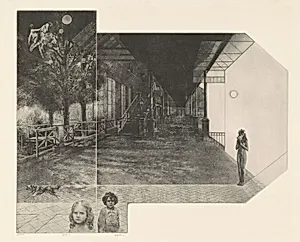
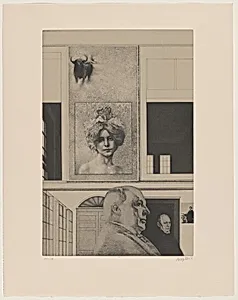
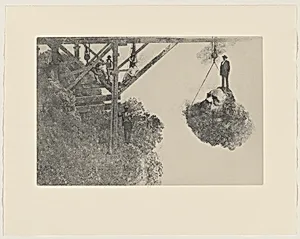
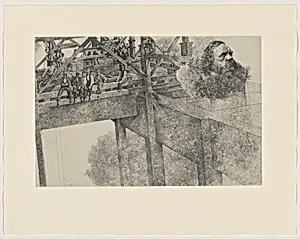
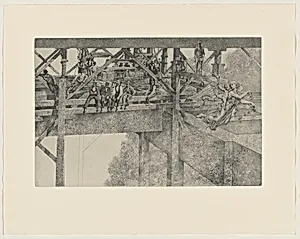
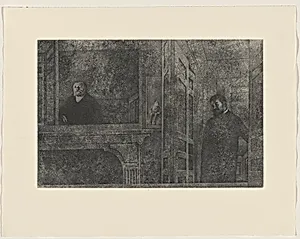
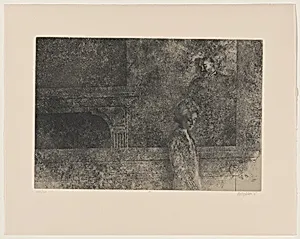
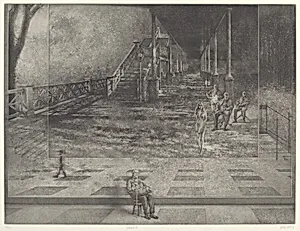
Milton's mastery of etching, engraving, and aquatint produced densely narrative prints blending photorealistic detail with visionary surrealism, compressing historical, literary, architectural, and mythological elements into dreamlike tableaux that evoke memory and hidden temporal juxtapositions.) Working in the tradition of Yale's rigorous design principles under Albers, he created intricate worlds of European cityscapes, invented structures, and literary allusions—from Henry James to Proust—rendered with exquisite tonal range from luminous whites to velvety blacks. After teaching at the Maryland Institute College of Art from 1961 to 1968, he settled in Francestown, New Hampshire, in 1969, devoting himself fully to printmaking in a converted barn studio.
Key works include his first lift-ground etching in 1960, Panorama 1 (1963), the landmark Jolly Corner Suite (published 1971), inspired by Henry James; the Interiors series culminating in The Train from Munich (1990); Aspern Papers drawings and print (1991); Points of Departure I: Mary's Turn and II: Nijinsky Variations (1993); Hidden Cities II: Embarkation for Cythera (2004); and Sight Lines 1: Tracking Shot (2007), his debut digital intaglio hybrid. Comprehensive catalogs document his oeuvre: Complete Etchings 1960-1976 (1975) and Complete Prints 1960-1996 (1996).)
Milton's prints grace over 100 major collections, including the Metropolitan Museum of Art, Museum of Modern Art, British Museum, Tate Gallery, and National Gallery of Art. Honored with grand prizes from Seoul (1972) to Norway (1999) and retrospectives at the de Young Museum (1996) and Flint Institute of Arts (2018), he remains a towering figure in contemporary printmaking, pushing technical boundaries into digital realms while sustaining a profound narrative depth.