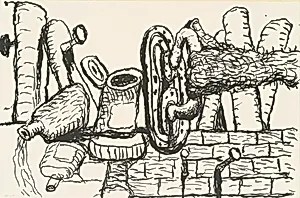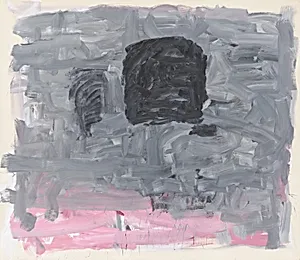
Philip Guston (1913–1980) was a Canadian-born American painter whose career traced a remarkable arc from Social Realism through Abstract Expressionism to a radically personal form of figurative painting that has profoundly influenced contemporary art. Born Phillip Goldstein in Montreal, he grew up in Los Angeles, where he befriended Jackson Pollock at Manual Arts High School and was largely self-taught as an artist.
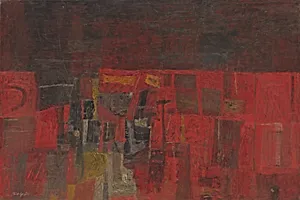
In the 1930s and 1940s, Guston established himself as a leading muralist and easel painter in the Social Realist tradition, producing works addressing racial injustice and political violence, including powerful depictions of Ku Klux Klan figures. In the late 1940s he transitioned to abstraction, creating luminous, atmospheric canvases of clustered brushstrokes in delicate pinks, reds, and grays that earned him recognition as a leading Abstract Expressionist and a Guggenheim Fellowship.
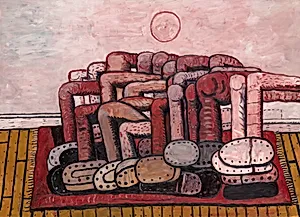
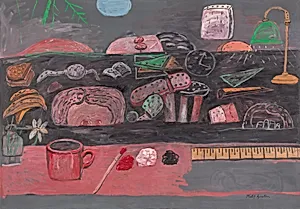
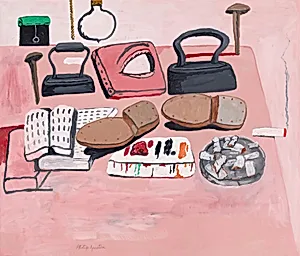
In 1968, Guston shocked the art world by abandoning abstraction and returning to figuration with a deliberately crude, cartoonish style. Paintings of hooded Klansmen, disembodied legs, lightbulbs, shoes, cigarettes, and clocks — rendered in fleshy pinks and blacks — were initially reviled by critics but have since come to be regarded as among the most important paintings of the late twentieth century. These late works confronted evil, complicity, mortality, and the absurdity of existence with an unflinching honesty.
Guston's late paintings have become enormously influential for subsequent generations, inspiring artists from Neo-Expressionists to contemporary painters. His work is held by the Museum of Modern Art, the National Gallery of Art, the Tate, and major museums worldwide.

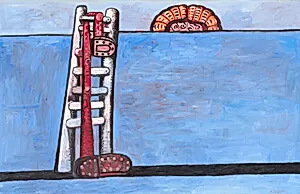
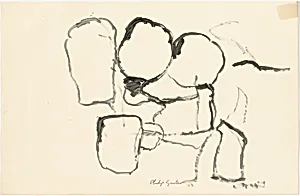
![Sea Group [special proof]](https://images.artheonmuseum.org/nga/thumb/sea-group-special-proof-nga-70847.webp)
![Studio Corner [special proof]](https://images.artheonmuseum.org/nga/thumb/studio-corner-special-proof-nga-70848.webp)
![Agean [special proof]](https://images.artheonmuseum.org/nga/thumb/agean-special-proof-nga-70849.webp)
![Gulf [special proof]](https://images.artheonmuseum.org/nga/thumb/gulf-special-proof-nga-70850.webp)
![Studio Forms [special proof]](https://images.artheonmuseum.org/nga/thumb/studio-forms-special-proof-nga-70851.webp)
![Painter [special proof]](https://images.artheonmuseum.org/nga/thumb/painter-special-proof-nga-70852.webp)
![Group [special proof]](https://images.artheonmuseum.org/nga/thumb/group-special-proof-nga-70855.webp)
![Curtain [special proof]](https://images.artheonmuseum.org/nga/thumb/curtain-special-proof-nga-70854.webp)
![View [special proof]](https://images.artheonmuseum.org/nga/thumb/view-special-proof-nga-70853.webp)
![Scene [special proof]](https://images.artheonmuseum.org/nga/thumb/scene-special-proof-nga-70856.webp)
![Shoes [special proof]](https://images.artheonmuseum.org/nga/thumb/shoes-special-proof-nga-70859.webp)
![Door [special proof]](https://images.artheonmuseum.org/nga/thumb/door-special-proof-nga-70858.webp)
![Objects [special proof]](https://images.artheonmuseum.org/nga/thumb/objects-special-proof-nga-70860.webp)
![Sky [special proof]](https://images.artheonmuseum.org/nga/thumb/sky-special-proof-nga-70862.webp)
![Easel [special proof]](https://images.artheonmuseum.org/nga/thumb/easel-special-proof-nga-70861.webp)