Philip Pearlstein (1924–2022) was an American painter whose unsparing, rigorously observed figurative paintings placed him at the forefront of a return to realism in American art during the 1960s and after. Born in Pittsburgh, Pennsylvania, Pearlstein studied at the Carnegie Institute of Technology before moving to New York, where he completed a graduate degree at New York University's Institute of Fine Arts. His early career unfolded against the overwhelming dominance of Abstract Expressionism, and his deliberate turn toward the painted nude figure represented a principled and somewhat contrarian commitment to sustained looking and objective description.
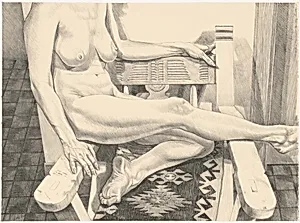
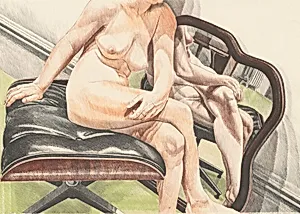
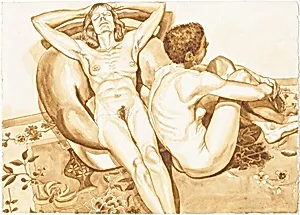
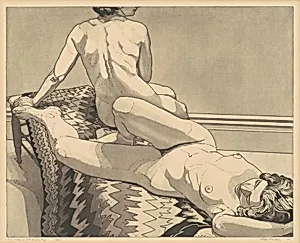
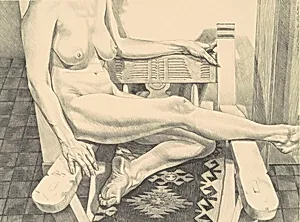
Pearlstein's mature style is immediately recognizable: his paintings depict nude models — typically two or more — in studio settings, cropped by the picture's edges in ways that deliberately deny full bodily presence while insisting on the sheer physical reality of flesh, weight, and surface. His figures are rendered with meticulous attention to the specific qualities of skin under studio light, without idealization, psychological narrative, or the kind of eroticized address common to the academic nude tradition. The paintings resist both the heroic humanism of the classical tradition and the emotional urgency of Abstract Expressionism, proposing instead a cool, analytical, almost clinical form of attention.
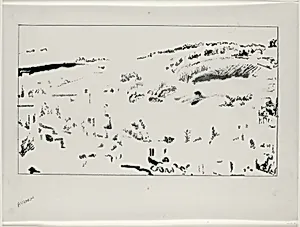
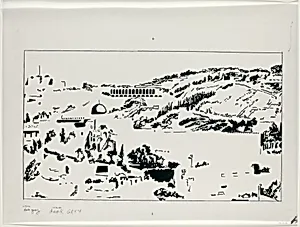
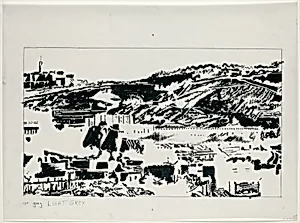
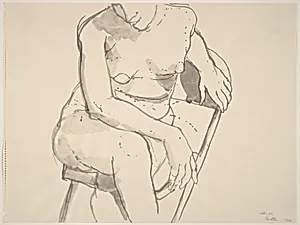
In addition to his paintings, Pearlstein produced a distinguished body of prints — etchings, lithographs, and screen prints — in which his characteristic concerns with cropping, light, and unidealized form were explored with equal rigor.
His long teaching career at Brooklyn College brought his ideas to generations of students, and his published writings helped articulate the theoretical basis for a non-Expressionist realism that influenced many younger artists. Pearlstein's reputation has grown steadily in recent decades, and he is now recognized as one of the most important American figurative painters of the postwar era.