
Ctrl K
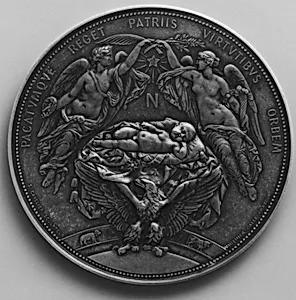
Pierre-Jules Cavelier (1814–1894) and André Vauthier-Galle (1818–1899) were esteemed French academic sculptors and medallists whose paths converged in the mid-19th century Parisian art scene, most notably in their collaboration on the exquisite medal *Cradle of the Prince Imperial* (1856). Born in Paris, Cavelier was the son of draftsman Adrien Louis Marie Cavelier and entered the École des Beaux-Arts in 1831, studying under sculptor Pierre-Jean David d'Angers and painter Paul Delaroche. He secured the prestigious Prix de Rome in 1842 for his plaster statue *Diomedes Entering the Palladium*, residing at the Villa Medici from 1843 to 1847. Vauthier-Galle, grandson of renowned medallist André Galle, trained under his grandfather, Louis Petitot, and Paul Blondel at the same École des Beaux-Arts. He won the Prix de Rome in 1839 for engraving in medal and stone with *Hercule étouffant Antée*, pensioned at the Villa Medici from 1840 to 1844, and later worked at the Atelier général du timbre designing banknotes until 1878.
Both artists embodied the rigorous neoclassical academic tradition of Second Empire France, favoring idealized mythological and historical subjects rendered with precise anatomy and classical proportions. Cavelier's oeuvre includes the poignant marble *Pénélope endormie* (1849, Musée d'Orsay), the maternal group *Cornélie, mère des Gracques* (1861, Musée d'Orsay), and public commissions like the stone group *La Durance* (1869) atop Marseille's Palais Longchamp, alongside busts of figures such as Blaise Pascal (1854) and Horace Vernet (1859). Vauthier-Galle excelled in medals and smaller sculptures, producing works like the marble *Omphale* (1858) and various commemorative medals, including those for the Lycée Janson-de-Sailly (1895). Their joint medal for the Prince Imperial exemplifies the era's blend of imperial pomp and technical virtuosity in relief sculpture.
Cavelier's legacy endures through his 1864 appointment as professor at the École des Beaux-Arts, where he mentored luminaries like Louis-Ernest Barrias, Eugène Guillaume, Alfred Gilbert, and George Grey Barnard, and his 1865 election to the Académie des Beaux-Arts; he earned the Légion d'Honneur in 1861. Vauthier-Galle contributed to numismatics and engraving, exhibiting at the Salon from 1852 to 1862. Together, they represent the École des Beaux-Arts' golden age, bridging grand sculpture and intricate medallic art for posterity.