Ctrl K
1574–1588
**Pietro da Barga: The Medici's Bronze Master of Classical Reductions**
Pietro Simoni da Barga, an Italian sculptor active in Florence from 1574 to 1588, emerged from the Tuscan town of Barga to become a favored artisan of Cardinal Ferdinando de' Medici, who later ascended as Grand Duke Ferdinando I of Tuscany. Employed specifically to craft small-scale bronze copies of renowned ancient sculptures unavailable for acquisition, da Barga filled the cardinal's collections with exquisite reductions listed in Medici inventories. His early life and training remain not well documented, though his work reflects deep immersion in Florence's vibrant late Renaissance sculpture scene.
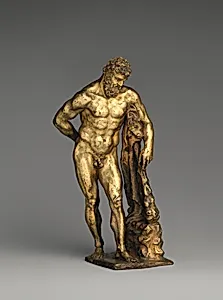
Da Barga worked in the Florentine tradition of Mannerist bronzework, producing statuettes prized for their waxy surfaces, finely modeled hands and feet, and dynamic poses echoing Hellenistic and Roman originals. These pieces, often patinated in rich browns or golds, were designed for princely studioli and niches, capturing the Renaissance fascination with antiquity while adapting it to portable luxury formats. His output included faithful replicas like the Farnese Hercules and Belvedere Antinous, blending technical precision with subtle interpretive flair.
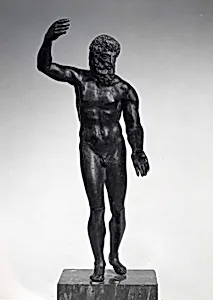
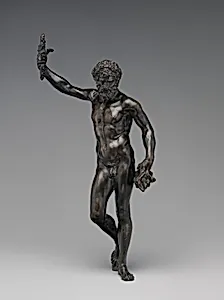
Among his verified major works are the Neptune (ca. 1580, Metropolitan Museum of Art), a copper alloy figure possibly doubling as Jupiter, standing nearly 28 cm tall with verdigris patina; the Farnese Hercules (modeled ca. 1576, Metropolitan Museum of Art), gilt on the front for niche display; Mars with Scimitar (ca. 1580, Bargello, after Giambologna); and Pluto and Proserpina (Bargello), a composition later echoed in Bernini's Baroque masterpiece. Other attributions include the Medici Lion (ca. 1575), a Satyr, and a Titan, showcasing his range from gods to mythological beasts.,_1580_ca._(bargello).jpg)
Da Barga's legacy endures in major collections like the Met, V&A, and Bargello, where his bronzes exemplify Medici patronage's role in preserving classical ideals. Auction records show continued demand, with pieces fetching thousands, affirming his status as a bridge between antiquity and the Grand Ducal era. Though his career spanned just over a decade, these diminutive yet monumental works illuminate Florence's golden age of bronze sculpture.
All 3 artworks loaded