
Ctrl K
1795–1895
Polly Platt, an American needlework artist born in Athens, New York, in 1795, exemplified the skilled craftsmanship of early nineteenth-century schoolgirls through her surviving embroidered sampler. At the age of fourteen, she attended the Pleasant Valley Quaker Boarding School in Dutchess County, New York, where her grandparents resided, immersing herself in the rigorous curriculum that emphasized moral instruction, literacy, and practical arts like embroidery. This Quaker institution, known for producing finely wrought textiles, provided Platt with the structured training typical of female academies of the era, blending education in geography, history, and needlework to prepare young women for domestic roles.
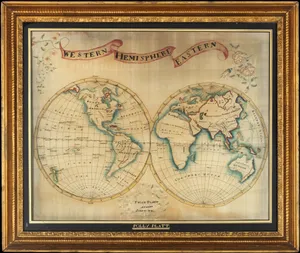
Platt's major work, a map sampler dated July 20, 1809, and inscribed "Polly Platt / Athens," depicts a double-hemisphere world map rendered in silk and chenille embroidery on silk (16 1/8 x 20 inches). Worked over a printed textile base, it showcases the Western and Eastern Hemispheres with continental outlines, oceans, and decorative motifs, highlighting the United States and Great Britain prominently—a nod to transatlantic educational exchanges. Now in the collection of The Metropolitan Museum of Art, this piece stands as a rare surviving example from Pleasant Valley, demonstrating Platt's precision in stitching and her grasp of cartographic details at a young age.
Rooted in the British late-eighteenth-century tradition of map samplers that migrated to North America, Platt's embroidery reflects the Quaker school's emphasis on utilitarian beauty and worldly knowledge filtered through moral lenses. These works served dual purposes: honing sewing skills essential for homemaking while imparting geography to foster informed citizenship. Though sparsely documented beyond this artifact, Platt's output aligns with the folk art practices of rural New York Quaker communities, where girls transformed printed maps into personalized, tactile learning tools.
Platt lived to the remarkable age of 100, passing in 1895, a testament to her era's longevity amid frontier hardships. Her sampler endures as a window into early American girls' education, preserving not just artistic skill but the cultural priorities of Quaker pedagogy. Featured in museum exhibitions on American textiles, it underscores the overlooked contributions of women like Platt to the nation's visual and educational heritage.
All 1 artworks loaded