
Ctrl K
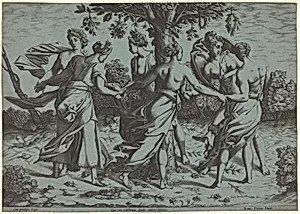
**The anonymous engraver known as “Probably French 16th Century after Pierre Milan after Rosso Fiorentino”** represents the vibrant but often unattributed world of French printmaking in the mid-to-late sixteenth century. Early life details for this artist remain undocumented, as is common for many craftsmen who worked in the orbit of the royal workshops at Fontainebleau. Active during the period when Italian Mannerist designs were being widely disseminated through reproductive engravings, this printmaker specialized in copying and adapting compositions originally created by the Italian painter Rosso Fiorentino and first engraved by the Parisian master Pierre Milan.
Pierre Milan (French, active 1537–1540) had already established himself as one of the earliest and most skilled engravers to translate Rosso’s inventive designs—intended for frescoes, stucco, and decorative objects at the Château de Fontainebleau—into print. The anonymous artist in question produced a faithful but distinct version of Milan’s celebrated *Dance of the Dryades* (also called *Dance of the Dryads*), an engraving on blue paper that captures a lively circle of mythological nymphs in dynamic poses, flowing drapery, and wooded surroundings. This work exemplifies the elegant, elongated figures and ornamental complexity of the Fontainebleau school, filtered through successive layers of French interpretation.
Stylistically, the engraver worked firmly within the French tradition of reproductive printmaking that flourished after Rosso’s arrival in France in 1530. While not an innovator of original designs, this artist contributed to the broader circulation of Mannerist imagery across Europe by producing accessible engravings that preserved the sophisticated vocabulary of the School of Fontainebleau. The single known work associated with this hand—the *Dance of the Dryades* now in the National Gallery of Art, Washington—demonstrates technical competence in line work and tonal modeling on colored paper, a medium favored for its decorative effect.
Although the engraver’s personal identity is lost to history, the print stands as a testament to the collaborative and reproductive nature of sixteenth-century French art. By faithfully transmitting Rosso’s and Milan’s compositions, such anonymous craftsmen helped embed Italian Mannerism into French visual culture, influencing subsequent generations of artists, goldsmiths, and decorators. The survival of this single attributed impression underscores the vital role of prints in preserving and popularizing the artistic legacy of Fontainebleau.