Ctrl K
1847–1919
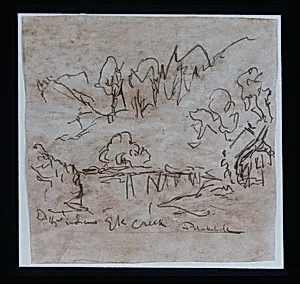
Ralph Albert Blakelock was born on October 15, 1847, in New York City to English-born physician Ralph B. Blakelock and Caroline Olinarg Blakelock. Intending to follow in his father's footsteps, he enrolled at the Free Academy of the City of New York (now City College) in 1864 to study medicine but dropped out after two or three terms, rejecting formal education. Entirely self-taught, Blakelock honed his skills through notebooks, memory, and intuition. In 1869, at age 21, he embarked on a solitary three-year journey through the American West, sketching Native American encampments and dramatic landscapes amid tribes far from settlements—a pivotal inspiration for his oeuvre. Returning in 1872, he married Cora Rebecca Bailey in 1877; the couple had nine children amid chronic financial hardship.
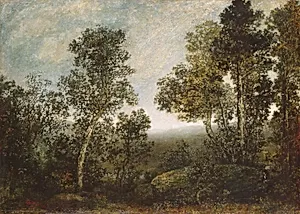
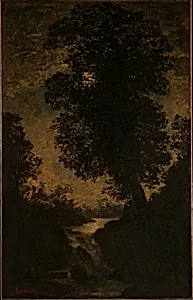
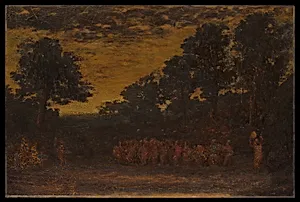
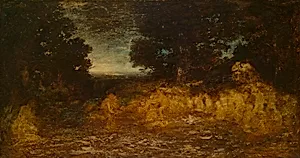
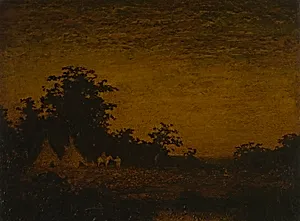
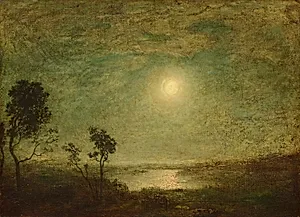
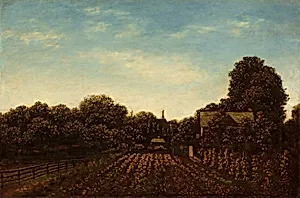
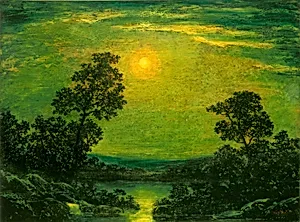
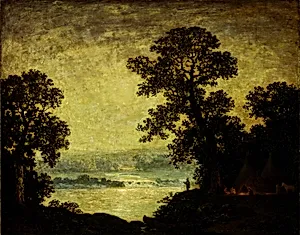
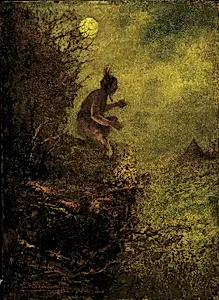
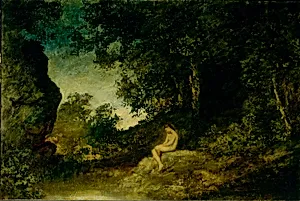
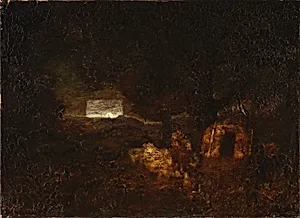
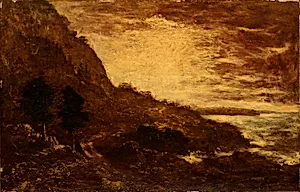
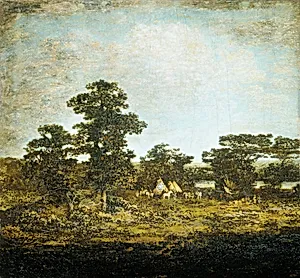
Blakelock's early landscapes echoed the Hudson River School tradition before evolving into a deeply personal romanticist style aligned with Tonalism, marked by luminous impasto, moody nocturnal lighting, and mysterious veils of moonlight filtering through dense forests or over Indian camps. Influenced by the French Barbizon School's textured surfaces, he layered paint thickly, scoring and scraping it to evoke solitude and introspection, often drawing from improvised piano melodies for emotional depth. Standout works include *Solitude* (1869, Tucson Museum of Art), *Indian Encampment* (1870, Midwest Museum of American Art), *Moonlight, Indian Encampment* (c. 1885–1890, Smithsonian American Art Museum), *Moonlight Sonata* (1889–1892, Museum of Fine Arts, Boston), and *Ghost Dance (The Vision of Life)* (1895–97, Art Institute of Chicago). He exhibited regularly at the National Academy of Design and befriended painter Harry Watrous around 1886, who provided studio space and sales support.
Tragedy shadowed Blakelock's genius: financial woes and depression culminated in breakdowns in 1891 and 1899, leading to nearly two decades in mental institutions like Middletown State Homeopathic Hospital, where he painted modestly on cardboard. During his confinement, his fame surged—works fetched record prices, like $20,000 at auction in 1916—and he was elected a National Academy Academician that year, even visiting Manhattan for a retrospective. Yet forgeries proliferated, complicating his legacy as one of America's most individual painters alongside Albert Pinkham Ryder. Blakelock died on August 9, 1919, in Elizabethtown, New York, a poignant symbol of unrecognized brilliance reclaimed too late.