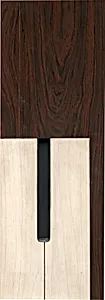
Richard Artschwager (1923–2013) was a singular American artist whose sculptures, paintings, and installations blurred the lines between everyday objects and high art, evoking associations with Pop Art, Minimalism, and Conceptualism. Born in Washington, D.C., to a Prussian botanist father and a Ukrainian-Jewish mother who instilled in him a love of art through her own studies at the Corcoran School of Art, Artschwager spent part of his youth in Las Cruces, New Mexico, after the family relocated for his father's health. Initially trained in science, he earned a BA in physics from Cornell University in 1948 following World War II service, then studied under Purist painter Amédée Ozenfant in Paris. Returning to New York, he supported his family through odd jobs, including furniture making, which profoundly shaped his artistic output after a studio fire in 1958 prompted a pivot to art.
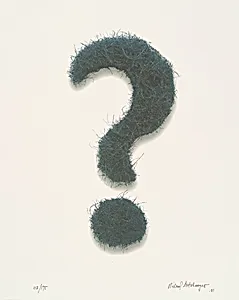
Artschwager's breakthrough came in the 1960s with hybrid sculptures mimicking domestic furniture, crafted from industrial materials like Formica and Celotex to probe perception and illusion. Table with Pink Tablecloth (1964) exemplifies this, transforming a prosaic object into a trompe l'oeil sculpture that confounds sculpture and painting, reality and representation. His grisaille paintings, often derived from photographs, adopted a TV-static-like texture, while "blps"—enlarged punctuation marks in materials like horsehair and acrylic—disrupted space, as in the dispersed installation 100 Locations (1968) at the Whitney Museum. Debuting at Leo Castelli Gallery in 1965, these works upended conventions, blending Pop's consumer references with Minimalism's geometry and Conceptualism's linguistic play.
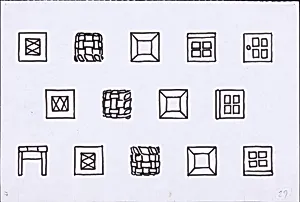
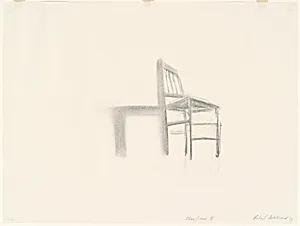
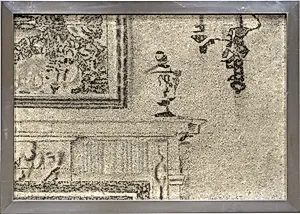
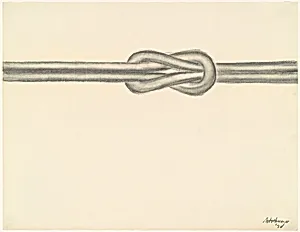
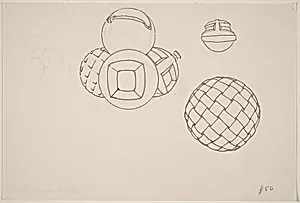
Later series expanded these motifs: the Door, Window, Table, Basket, Mirror, Rug drawings (1974–75), shipping-crate sculptures (1990s), and piano laminates (2012), alongside site-specific interventions like mirrors and doors that fragmented interiors. Major retrospectives, including at the Whitney (1988–89 and 2012–14, traveling internationally), affirmed his influence, seen in documenta appearances and collections worldwide.
Artschwager's legacy endures in artists like Haim Steinbach and Rachel Harrison, who echoed his domestic hybrids and perceptual games, cementing his role as a maverick who made the familiar profoundly strange for over five decades.

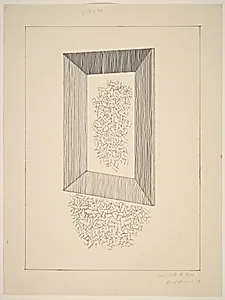
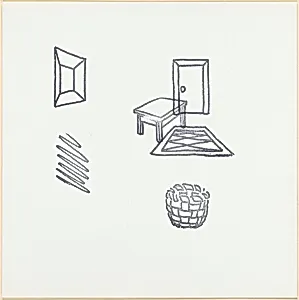
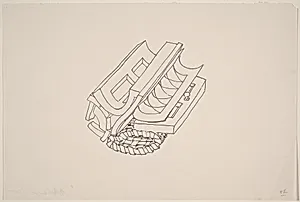
![Basket, Table, Door, Window, Mirror, Rug #42 [recto]](https://images.artheonmuseum.org/nga/thumb/basket-table-door-window-mirror-rug-42-recto-nga-74566.webp)
![Basket, Table, Door, Window, Mirror, Rug #42 [verso]](https://images.artheonmuseum.org/nga/thumb/basket-table-door-window-mirror-rug-42-verso-nga-74567.webp)
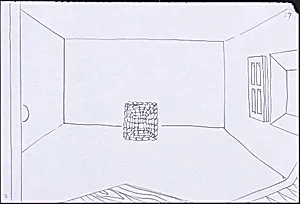
![Basket, Table, Door, Window, Mirror, Rug [verso]](https://images.artheonmuseum.org/nga/thumb/basket-table-door-window-mirror-rug-verso-nga-74562.webp)
![Basket, Table, Door, Window, Mirror, Rug #41 [recto]](https://images.artheonmuseum.org/nga/thumb/basket-table-door-window-mirror-rug-41-recto-nga-74561.webp)
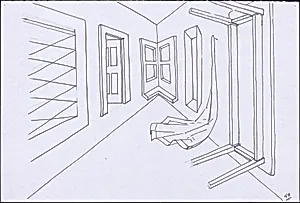
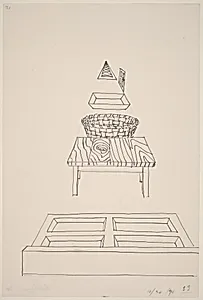
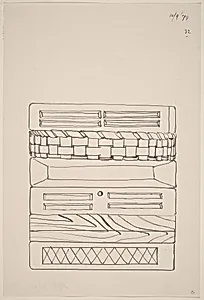
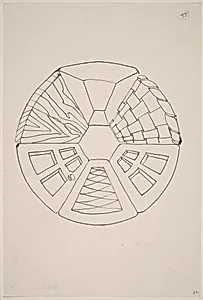
![Basket, Table, Door, Window, Mirror, Rug #7 [recto]](https://images.artheonmuseum.org/nga/thumb/basket-table-door-window-mirror-rug-7-recto-nga-74563.webp)
![Basket, Table, Door, Window, Mirror, Rug #39 [recto]](https://images.artheonmuseum.org/nga/thumb/basket-table-door-window-mirror-rug-39-recto-nga-74552.webp)
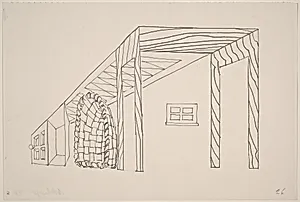
![Basket, Table, Door, Window, Mirror, Rug #40 [verso]](https://images.artheonmuseum.org/nga/thumb/basket-table-door-window-mirror-rug-40-verso-nga-74553.webp)
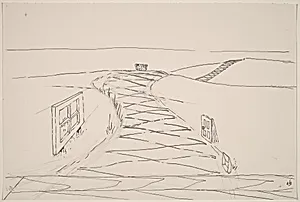
![Basket, Table, Door, Window, Mirror, Rug #8 [verso]](https://images.artheonmuseum.org/nga/thumb/basket-table-door-window-mirror-rug-8-verso-nga-74564.webp)