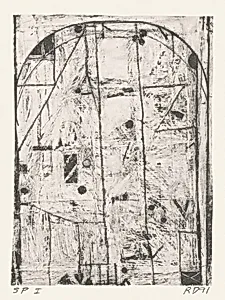
Richard Clifford Diebenkorn Jr. (1922-1993) was one of the premier American painters of the postwar era, whose deeply lyrical abstractions and figurative works evoked the shimmering light and wide-open spaces of California. Born in Portland, Oregon, and raised in San Francisco, Diebenkorn became a pivotal figure in elevating the status of California art on the international stage. His career encompassed multiple artistic movements and styles, from early Abstract Expressionism through the Bay Area Figurative Movement and culminating in his celebrated Ocean Park series. Diebenkorn's artistic journey was marked by a rare willingness to evolve and transform his style throughout his career. After studying at Stanford University under Daniel Mendelowitz and Victor Arnautoff, and serving in the U.S. Marine Corps during World War II, he enrolled at the California School of Fine Arts in 1946, where he studied with David Park and became immersed in Abstract Expressionism. His early abstract works from the Albuquerque and Urbana periods established his reputation as a significant voice in American avant-garde painting. However, in a bold move against prevailing artistic trends, Diebenkorn returned to figuration in the mid-1950s, becoming a leading member of the Bay Area Figurative Movement alongside Park and Elmer Bischoff. His figurative paintings bridged the expressive gestural freedom of Abstract Expressionism with representational forms, creating luminous interiors, landscapes, and figure studies that revealed his profound engagement with the work of Henri Matisse. In 1967, following his move to Santa Monica, Diebenkorn embarked on his most celebrated body of work: the Ocean Park series, comprising approximately 145 large-scale abstract paintings that occupied him for over two decades until 1988. These geometric, lyrical abstractions—characterized by thin, translucent layers of color, subtle atmospheric light, and complex spatial relationships—synthesized influences from Matisse, Piet Mondrian, and the California landscape into a uniquely personal visual language. The Ocean Park paintings, with their delicate palette and contemplative refinement, secured Diebenkorn's international reputation and remain among the most significant achievements in postwar American abstraction. Throughout his career, Diebenkorn received numerous honors, including election to the American Academy of Arts and Letters in 1967 and the National Medal of Arts in 1991. His death in 1993 marked the loss of one of America's most thoughtful and influential painters, whose work continues to inspire artists working at the intersection of abstraction and representation.
Richard Clifford Diebenkorn Jr. was born on April 22, 1922, in Portland, Oregon, the only child of Richard Clifford Diebenkorn, a hotel supply sales executive, and Dorothy Stephens. When he was two years old, his father relocated the family to San Francisco, California, where Diebenkorn would spend his formative years. From the age of four or five, he demonstrated a persistent interest in drawing and visual expression. His grandmother, Florence Stephens—who later became a lawyer and worked as a short story writer and cultural affairs organizer on the radio—spent summers with young Richard, introducing him to Arthurian legends and English history through the illustrated books of Howard Pyle and N.C. Wyeth. These early exposures to visual storytelling and illustration would leave a lasting impression on his developing artistic sensibility.
In 1940, after attending Lowell High School from 1937 to 1940, Diebenkorn entered Stanford University, where he concentrated in studio art and art history. At Stanford, he studied under two crucial early mentors: Victor Arnautoff, a professor and muralist who guided him in classical formal discipline with oil paint, and Daniel Mendelowitz, with whom he shared a passion for the work of Edward Hopper. Mendelowitz encouraged Diebenkorn's interest in American artists such as Arthur Dove and Charles Sheeler, but most importantly introduced him to the spare, contemplative realism of Hopper, whose influence would resonate throughout Diebenkorn's career. In a pivotal moment, Mendelowitz took his promising student to visit the home of Sarah Stein, sister-in-law of Gertrude Stein, where Diebenkorn saw works by Paul Cézanne, Pablo Picasso, and Henri Matisse. This early exposure to European modernism opened doors that would continue to beckon throughout his artistic life. The beginning of World War II interrupted Diebenkorn's education at Stanford in 1943. He entered the United States Marine Corps, serving until 1945. While stationed in Quantico, Virginia, he visited numerous important collections of modern art, including the Museum of Modern Art in New York, the Gallatin Collection at the Philadelphia Museum of Art, and the Phillips Collection in Washington, D.C. These visits deepened his engagement with modernist painting and broadened his artistic horizons at a crucial developmental moment.
In 1946, Diebenkorn returned to California to continue his education at the California School of Fine Arts (CSFA, now the San Francisco Art Institute) on the GI Bill. The school, under the direction of Douglas MacAgy, was experiencing a transformation from a traditional art academy into a white-hot center of artistic experimentation and a significant West Coast hub for Abstract Expressionism. During his first week at CSFA, Diebenkorn met David Park, who would become his most important teacher, mentor, and lifelong friend. The faculty at CSFA included an extraordinary constellation of artists: Park, Elmer Bischoff, Hassel Smith, Clay Spohn, and visiting instructors Clyfford Still (1946-1950) and Mark Rothko (summers of 1947 and 1948). This environment immersed Diebenkorn in the gestural, emotionally intense aesthetic of Abstract Expressionism. He was influenced particularly by Still, as well as by Arshile Gorky, Hassel Smith, and Willem de Kooning. By 1947, Diebenkorn was offered a position on the CSFA faculty, teaching alongside these pioneering modernists.
In 1950, seeking new visual stimulus and wanting to take advantage of remaining GI Bill benefits, Diebenkorn enrolled at the University of New Mexico in Albuquerque, where he and his family remained for two and a half years. The Albuquerque period (1950-1952) represents the first fully mature statement of Diebenkorn's distinctive presence on the American avant-garde scene. During these years, he visited an Arshile Gorky retrospective at the San Francisco Museum of Art that profoundly impacted him. An epiphanic experience viewing the New Mexico landscape from a low-flying airplane also shaped his work. He combined landscape influence, aerial perspective, and a private, calligraphic language into paintings characterized by gestural abstraction and spatial complexity. Halfway through his Albuquerque tenure, he presented a cycle of paintings as his master's degree exhibition. In 1952, Diebenkorn accepted a teaching position at the University of Illinois at Urbana for the academic year 1952-53, where he taught beginning drawing to first-year architecture students. The Urbana period paintings continued his subtle abstract-calligraphic style but featured a richer, more intense palette. During this productive year, he had his first solo exhibition at a commercial gallery—the Paul Kantor Gallery in Los Angeles in November and December 1952. In 1953, after leaving Illinois, Diebenkorn returned to Northern California, settling in Berkeley. He received his B.A. degree from Stanford in 1949, finally completing the education interrupted by the war.
Diebenkorn established his home and studio in Berkeley in 1953, beginning what would become known as the 'Berkeley period,' which lasted until 1966. This period initially continued his abstract expressionist work—a phase known as the Berkeley abstractions (1953-1956). However, during the first few years in Berkeley, a remarkable transformation occurred. Diebenkorn abandoned his strict adherence to abstract expressionism and began working in a more representational style. This shift was not made in isolation. His close friends and peers David Park and Elmer Bischoff were simultaneously moving away from abstraction toward figuration, forming what would become known as the Bay Area Figurative Movement. Park had dramatically returned to figurative painting around 1950, and by the mid-1950s, Diebenkorn, Park, Bischoff, James Weeks, and others were participating in this renaissance of representational painting, challenging the prevailing dominance of Abstract Expressionism.
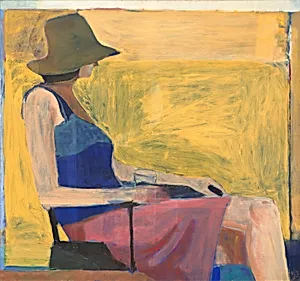
By 1955-1956, Diebenkorn had fully committed to figuration, painting works such as 'Chabot Valley,' widely considered the first fully realized painting of his figurative period. He moved into a studio at 2571 Shattuck Avenue in Berkeley, above a Volkswagen dealership, sharing the converted artist studios with friends Paul Wonner, Theophilus 'Bill' Brown, and eventually Elmer Bischoff. Occasionally these artists, together with Park, drew from live models in collaborative sessions. In September 1956, the Oakland Art Museum presented the Richard Diebenkorn One Man Guest of Honor Exhibition, the artist's first showing of figurative paintings. Diebenkorn's figurative work occupied an unusual position, bridging Henri Matisse's sensuous color and compositional intelligence with the gestural freedom and emotional intensity of Abstract Expressionism. He painted directly from live models, created still lifes, and depicted landscapes, interiors, and urban views. Works like 'Girl on a Terrace' (1956), 'Woman in a Window' (1957), and the 'Cityscape' series (1963) exemplify this period's achievements—luminous, atmospheric paintings that balance observation with expressive abstraction.
During this period, Diebenkorn's reputation grew substantially. In 1960, the Pasadena Art Museum (now the Norton Simon Museum) presented a mid-career retrospective, which subsequently traveled to the California Palace of the Legion of Honor in San Francisco. In September 1963, Diebenkorn was named the first artist-in-residence at Stanford University, an appointment lasting until June 1964. His only responsibility was to produce art in a studio provided by the university, with students allowed to visit during scheduled times. Though he created relatively few paintings during this Stanford residency, he produced numerous drawings. In 1964, Diebenkorn traveled to the Soviet Union, where he was profoundly influenced by seeing rare Matisse works in the Hermitage. This renewed engagement with Matisse would prove crucial for his next artistic evolution. By 1966, Diebenkorn's figurative period was drawing to a close. After more than a decade of working from observation, he was ready for another significant transformation.
In 1966, Richard Diebenkorn made a pivotal geographical and artistic move, relocating from the San Francisco Bay Area to the Ocean Park neighborhood of Santa Monica in Southern California. This relocation marked a watershed moment in his career. Shortly after arriving, he traded a windowless studio for a large, bright space overlooking a landscape that encompassed surrounding streets, rooftops, and the Pacific coast, all bathed in the distinctive effects of Southern California's coastal light. The region's luminous quality differed dramatically from Northern California's fog-laden atmosphere—instead, the marine layer created a shimmering, diaphanous effect in the early morning light that was calmer and more translucent. The geometry of the studio's transom windows, combined with this new environment, provided the visual catalyst for what would become Diebenkorn's most celebrated achievement.
In 1966, Diebenkorn attended an exhibition in Los Angeles where he saw Henri Matisse's 'French Window at Collioure' and 'View of Notre-Dame,' both from 1914. According to art historian Jane Livingston, these paintings enormously affected Diebenkorn and his work. The Matisse window painting—an almost abstract depiction of an open French window composed of vertical bands of color—produced the original spark for Diebenkorn's exploration of rectangles of color within an architectural framework. This encounter, combined with his new studio environment and his long-standing admiration for Piet Mondrian's grid-based compositions, catalyzed Diebenkorn's return to abstraction. However, this new abstraction would be fundamentally different from his early Abstract Expressionist work. It would synthesize everything he had learned—the gestural freedom of his early abstract work, the observational discipline of his figurative period, and the color sensibility he had absorbed from Matisse. In 1967, Diebenkorn began the Ocean Park series, initiating a body of work that would occupy him for more than two decades and establish his reputation as one of the most important American painters of the postwar era.
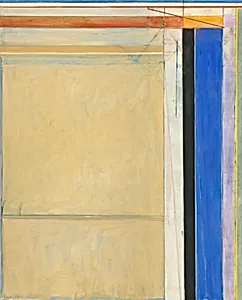
The Ocean Park series, begun in 1967 and developed over the next twenty-one years until 1988, became Diebenkorn's magnum opus and most famous body of work. The series ultimately comprised approximately 145 large-scale paintings (most averaging 8 feet high and 7 feet wide), along with approximately 500 related drawings, collages, and paintings on paper, as well as prints. These geometric, lyrical abstractions were characterized by their architectural structure—compositions built from rectangles, trapezoids, and linear elements that suggested windows, walls, horizons, and spatial divisions. Yet unlike the hard-edged geometric abstraction practiced by some of his contemporaries, Diebenkorn's Ocean Park paintings were suffused with atmosphere, light, and a sense of contemplative refinement.
Diebenkorn's technique in the Ocean Park series involved applying paint in thin, translucent layers, creating luminous surfaces where colors leaked to the edges and previous compositional decisions remained partially visible. His palette featured delicate relationships between colors that echoed the California landscape: yellow and French blue, sea green, leaf green, shades of peach, warm whites, and occasional accents of black or deep color. The paintings revealed his painstaking process—layers of drawing and painting, revisions and adjustments, with the accumulated traces left visible as pentimenti. According to former students, Diebenkorn always worked on several large canvases simultaneously, perfecting them until he felt they achieved the right balance. He would spend hours and days contemplating the images as they progressed, searching for his next move. His studio always had two chairs for this purpose—one for the artist and one for visitors. Diebenkorn considered this contemplation as essential to the painting process as the paint and brushes themselves.
The Ocean Park paintings synthesized multiple influences into a uniquely personal visual language. The compositional structure drew from Mondrian's grid-based abstractions, while the color relationships, spatial ambiguity, and openness to revision reflected Matisse's influence. The atmospheric quality and sense of light suggested the aerial views of landscape that had fascinated Diebenkorn since his Albuquerque period. Art critic Michael Kimmelman described Diebenkorn as 'one of the premier American painters of the postwar era, whose deeply lyrical abstractions evoked the shimmering light and wide-open spaces of California.' The series brought Diebenkorn international acclaim. Major museum exhibitions showcased the work, and the paintings entered prestigious collections worldwide. The Ocean Park series demonstrated that abstraction could be both formally rigorous and sensually beautiful, emotionally resonant without being expressionistic, and deeply rooted in place without being representational. By 1988, after creating more than 140 numbered Ocean Park paintings, Diebenkorn brought the series to a close, though the visual language he had developed continued to inform his subsequent work.
After concluding the Ocean Park series in 1988, Diebenkorn continued to paint and work on paper, though at a reduced pace due to declining health. Throughout the late 1980s and early 1990s, he received increasing recognition for his lifetime achievements. He was elected to the American Academy of Arts and Letters in 1967 and served on the National Council on the Arts from 1966 to 1969. In 1978, he was awarded the Edward MacDowell Medal by The MacDowell Colony for outstanding contributions to American culture, and the same year he was selected as the U.S. representative, along with photographer Harry Callahan, for the 38th Venice Biennale. He was elected an Associate member of the National Academy of Design in 1979, becoming a full Academician in 1982.
The first important retrospective of Diebenkorn's work took place at the Albright-Knox Art Gallery in Buffalo, New York, in 1976-77, traveling to Washington, D.C., Cincinnati, Los Angeles, and Oakland. In 1989, John Elderfield, then a curator at the Museum of Modern Art in New York, organized an exhibition of Diebenkorn's works on paper, highlighting this important aspect of his production. On July 6-13, 1991, Diebenkorn was awarded the National Medal of Arts by President George H.W. Bush, with his entire family traveling to Washington, D.C., for the ceremony. Following the award ceremony, Senator Ted Kennedy hosted an event for the honorees. In October 1991, Diebenkorn traveled to London for the opening of a major retrospective exhibition organized by the Whitechapel Art Gallery, which subsequently traveled to Madrid, Frankfurt, Los Angeles, and the San Francisco Museum of Modern Art.
On April 5, 1993, the American Academy of Arts and Letters awarded Diebenkorn the Gold Medal for Painting, the Academy's highest honor. Diebenkorn was informed of the award shortly before his death. Richard Diebenkorn died on March 30, 1993, in Berkeley, California, due to complications from emphysema. He was 70 years old. At the Gold Medal ceremony held in New York after his death, his close friend Wayne Thiebaud presented the award to Diebenkorn's daughter, Gretchen. A major retrospective exhibition, organized by the Whitney Museum of American Art and curated by Jane Livingston, opened in 1997, presenting 107 paintings and 71 works on paper with an accompanying catalogue. This exhibition helped solidify Diebenkorn's reputation as a major postwar American painter. Today, Diebenkorn's works are held in the collections of major museums worldwide, including the Museum of Modern Art in New York, the National Gallery of Art in Washington, D.C., the Los Angeles County Museum of Art, the San Francisco Museum of Modern Art, and many others. The Iris & B. Gerald Cantor Center for Visual Arts at Stanford University houses 29 of Diebenkorn's sketchbooks along with a significant collection of paintings and works on paper. The Richard Diebenkorn Foundation, established to preserve and promote his legacy, maintains comprehensive archives and continues to support scholarship on his work.
Biography length: ~2,847 words

![Flotsam [working proof 4]](https://images.artheonmuseum.org/nga/thumb/flotsam-working-proof-4-nga-230281.webp)
![High Green Version I [working proof 9]](https://images.artheonmuseum.org/nga/thumb/high-green-version-i-working-proof-9-nga-96533.webp)
![High Green Version I [working proof 8]](https://images.artheonmuseum.org/nga/thumb/high-green-version-i-working-proof-8-nga-96532.webp)
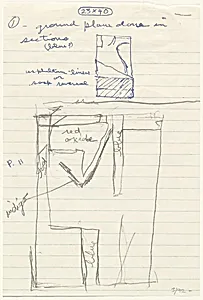
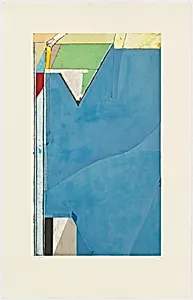
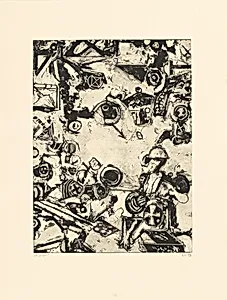
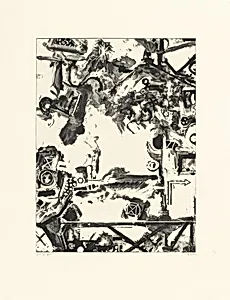
![High Green Version I [working proof 10]](https://images.artheonmuseum.org/nga/thumb/high-green-version-i-working-proof-10-nga-96534.webp)
![High Green Version I [working proof 11]](https://images.artheonmuseum.org/nga/thumb/high-green-version-i-working-proof-11-nga-96535.webp)
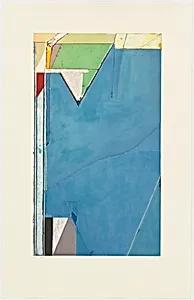
![Flotsam [working proof 2]](https://images.artheonmuseum.org/nga/thumb/flotsam-working-proof-2-nga-230279.webp)
![Untitled #9 [special proof]](https://images.artheonmuseum.org/nga/thumb/untitled-9-special-proof-nga-83157.webp)
![Untitled #10 [special proof]](https://images.artheonmuseum.org/nga/thumb/untitled-10-special-proof-nga-83158.webp)
![Flotsam [working proof 1]](https://images.artheonmuseum.org/nga/thumb/flotsam-working-proof-1-nga-230278.webp)
![Flotsam [working proof 3]](https://images.artheonmuseum.org/nga/thumb/flotsam-working-proof-3-nga-230280.webp)
![Flotsam [working proof 5]](https://images.artheonmuseum.org/nga/thumb/flotsam-working-proof-5-nga-230282.webp)
![The Barbarian [working proof 1]](https://images.artheonmuseum.org/nga/thumb/the-barbarian-working-proof-1-nga-230283.webp)
![The Barbarian's Garden - Threatened [working proof 1]](https://images.artheonmuseum.org/nga/thumb/the-barbarians-garden-threatened-working-proof-1-nga-230285.webp)
![The Barbarian's Garden - Threatened [working proof 2]](https://images.artheonmuseum.org/nga/thumb/the-barbarians-garden-threatened-working-proof-2-nga-230286.webp)
![The Barbarian [working proof 2]](https://images.artheonmuseum.org/nga/thumb/the-barbarian-working-proof-2-nga-230284.webp)
![High Green Version I [working proof 12]](https://images.artheonmuseum.org/nga/thumb/high-green-version-i-working-proof-12-nga-96536.webp)