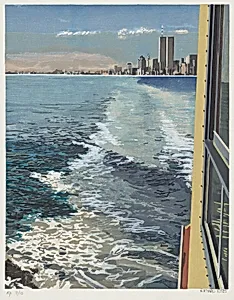
Richard Estes (born 1932) is an American painter universally recognized as one of the founding masters of Photorealism, a movement that emerged in the late 1960s and sought to render the visual world with a precision and detail that rivals or exceeds photographic documentation. Born in Kewanee, Illinois, Estes studied at the School of the Art Institute of Chicago before moving to New York City, where he worked for many years as a commercial illustrator and art director. The discipline and visual acuity demanded by commercial work proved formative, and when he began painting seriously in the mid-1960s he brought to fine art an extraordinary command of observed detail and compositional design.
Estes's signature subjects are the urban environments of New York and other cities — storefronts, diners, bus windows, reflective glass facades, and the layered visual complexity of the modern street. Where many of his Photorealist contemporaries focused on a single reflective surface, Estes constructs images of dizzying depth and simultaneity, combining multiple photographic references into compositions that are more visually complete than any single photograph could be. His surfaces are smooth and cool, unmarked by visible brushwork, yet the paintings are unmistakably the products of a human intelligence that selects, orders, and intensifies what the camera merely records.
Among his most celebrated works are the urban street scenes of Manhattan, depictions of the Staten Island Ferry, and views of urban storefronts whose plate-glass windows reflect the world outside in kaleidoscopic complexity. His work entered major museum collections and helped define Photorealism as a serious and enduring movement within contemporary American art.
Estes has been the subject of major retrospective exhibitions and is represented in the permanent collections of leading museums across the United States and Europe. His influence on subsequent generations of painters interested in precision, observation, and the relationship between painting and photography has been profound and lasting.

![Study VI, New York Harbor [recto, #24, brown-yellow]](https://images.artheonmuseum.org/nga/thumb/study-vi-new-york-harbor-recto-24-brown-yellow-nga-115473.webp)
![Study VI, New York Harbor [verso, #42, white]](https://images.artheonmuseum.org/nga/thumb/study-vi-new-york-harbor-verso-42-white-nga-115454.webp)
![Study VI, New York Harbor [recto, #8, brown]](https://images.artheonmuseum.org/nga/thumb/study-vi-new-york-harbor-recto-8-brown-nga-115448.webp)
![Study VI, New York Harbor [#1, white-gray]](https://images.artheonmuseum.org/nga/thumb/study-vi-new-york-harbor-1-white-gray-nga-112372.webp)
![Study VI, New York Harbor [recto, #4, yellow]](https://images.artheonmuseum.org/nga/thumb/study-vi-new-york-harbor-recto-4-yellow-nga-115444.webp)
![Study VI, New York Harbor [verso, #6, white-brown]](https://images.artheonmuseum.org/nga/thumb/study-vi-new-york-harbor-verso-6-white-brown-nga-115445.webp)
![Study VI, New York Harbor [#3, white-gray]](https://images.artheonmuseum.org/nga/thumb/study-vi-new-york-harbor-3-white-gray-nga-115443.webp)
![Study VI, New York Harbor [recto, #22, black-green]](https://images.artheonmuseum.org/nga/thumb/study-vi-new-york-harbor-recto-22-black-green-nga-115471.webp)
![Study VI, New York Harbor [verso, #25, blue-gray]](https://images.artheonmuseum.org/nga/thumb/study-vi-new-york-harbor-verso-25-blue-gray-nga-115449.webp)
![Study VI, New York Harbor [#9, blue-gray]](https://images.artheonmuseum.org/nga/thumb/study-vi-new-york-harbor-9-blue-gray-nga-115450.webp)
![Study VI, New York Harbor [verso, #7, brown]](https://images.artheonmuseum.org/nga/thumb/study-vi-new-york-harbor-verso-7-brown-nga-115447.webp)
![Study VI, New York Harbor [recto, # 10, gray-brown]](https://images.artheonmuseum.org/nga/thumb/study-vi-new-york-harbor-recto-10-gray-brown-nga-115451.webp)
![Study VI, New York Harbor [verso, #28, brown]](https://images.artheonmuseum.org/nga/thumb/study-vi-new-york-harbor-verso-28-brown-nga-115452.webp)
![Study VI, New York Harbor [recto, #11, blue-gray]](https://images.artheonmuseum.org/nga/thumb/study-vi-new-york-harbor-recto-11-blue-gray-nga-115453.webp)
![Study VI, New York Harbor [recto, #12, blue-gray]](https://images.artheonmuseum.org/nga/thumb/study-vi-new-york-harbor-recto-12-blue-gray-nga-115455.webp)
![Study VI, New York Harbor [verso, #41, gray-brown]](https://images.artheonmuseum.org/nga/thumb/study-vi-new-york-harbor-verso-41-gray-brown-nga-115456.webp)
![Study VI, New York Harbor [recto, #15, blue-green and gray]](https://images.artheonmuseum.org/nga/thumb/study-vi-new-york-harbor-recto-15-blue-green-and-nga-115466.webp)
![Study VI, New York Harbor [verso, #30, green and blue]](https://images.artheonmuseum.org/nga/thumb/study-vi-new-york-harbor-verso-30-green-and-blue-nga-115467.webp)
![Study VI, New York Harbor [#17, brown and brown-green]](https://images.artheonmuseum.org/nga/thumb/study-vi-new-york-harbor-17-brown-and-brown-green-nga-115468.webp)
![Study VI, New York Harbor [#18, brown and brown-green]](https://images.artheonmuseum.org/nga/thumb/study-vi-new-york-harbor-18-brown-and-brown-green-nga-115469.webp)
![Study VI, New York Harbor [#21, gray-green]](https://images.artheonmuseum.org/nga/thumb/study-vi-new-york-harbor-21-gray-green-nga-115470.webp)
![Study VI, New York Harbor [verso, #41, red-gray]](https://images.artheonmuseum.org/nga/thumb/study-vi-new-york-harbor-verso-41-red-gray-nga-115472.webp)