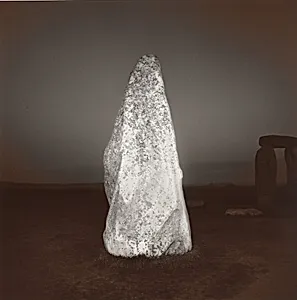
Richard Misrach, born in 1949 in Los Angeles, California, emerged as one of the most influential American photographers of his generation through his pioneering use of large-format color photography to explore the fraught intersections of nature, culture, and human intervention. Raised in a middle-class family, he briefly studied mathematics before earning a B.A. in Psychology from the University of California, Berkeley, in 1967. There, he learned the rudiments of photography under mentors Paul Herzoff, Roger Minick, and Steve Fitch at the ASUC Berkeley Studio, where he began documenting anti-war riots on campus. His early work, such as *Telegraph 3 A.M.* (1974), a poignant book of nighttime portraits of Berkeley's homeless population that won the Western Book Award, showcased his emerging command of color to blend aesthetics with social commentary.
Misrach's style, rooted in the renaissance of color photography during the 1970s, defied black-and-white fine art traditions, employing epic scales and serial imagery to document landscapes as metaphors for ecological, political, and sociological crises. His magnum opus, the ongoing *Desert Cantos* series (begun 1979), chronicles the American Southwest's deserts scarred by military testing, toxic spills, and abandonment, with standout volumes like *Bravo 20: The Bombing of the American West* (1991, co-authored with his wife Myriam Weisang Misrach) and *Violent Legacies* (1992). Sub-series such as "The Flood" (Salton Sea), "The Skies," and "Premonitions" (2009–2016, graffiti warnings) exemplify his fusion of beauty and devastation.
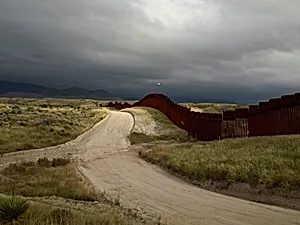
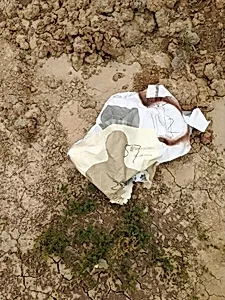
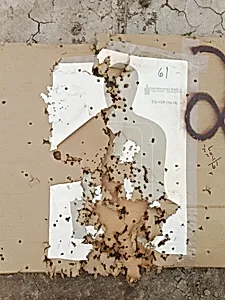
In later decades, Misrach expanded into multimedia collaborations and urgent environmental critiques, including *Petrochemical America* (1998–2012, with landscape architect Kate Orff, mapping Louisiana's "Cancer Alley"), *Border Cantos* (2004–, with composer Guillermo Galindo, transforming border detritus into sonic sculptures), *On the Beach* (2002–2005), and *Destroy This Memory* (2010, post-Katrina graffiti). Recent projects like *CARGO* (ongoing, book 2025) track container ships in San Francisco Bay, while commissions such as the UCSF Pritzker Psychiatry Building (2019–2022) integrate over 120 works. Honored with a Guggenheim Fellowship, four NEA grants, and the Lucie Award (2008), Misrach's oeuvre resides in major collections—including 151 prints at the National Gallery of Art—and continues to shape discourse on humanity's environmental legacy through exhibitions, books, and cultural references like HBO's *True Detective*.

![Untitled [New Orleans and the Gulf Coast, 2005]](https://images.artheonmuseum.org/nga/thumb/untitled-new-orleans-and-the-gulf-coast-2005-nga-152831.webp)
![Untitled [New Orleans and the Gulf Coast, 2005]](https://images.artheonmuseum.org/nga/thumb/untitled-new-orleans-and-the-gulf-coast-2005-nga-152830.webp)
![Untitled [New Orleans and the Gulf Coast, 2005]](https://images.artheonmuseum.org/nga/thumb/untitled-new-orleans-and-the-gulf-coast-2005-nga-152832.webp)
![Untitled [New Orleans and the Gulf Coast, 2005]](https://images.artheonmuseum.org/nga/thumb/untitled-new-orleans-and-the-gulf-coast-2005-nga-152833.webp)
![Untitled [New Orleans and the Gulf Coast, 2005]](https://images.artheonmuseum.org/nga/thumb/untitled-new-orleans-and-the-gulf-coast-2005-nga-152851.webp)
![Untitled [New Orleans and the Gulf Coast, 2005]](https://images.artheonmuseum.org/nga/thumb/untitled-new-orleans-and-the-gulf-coast-2005-nga-152871.webp)
![Untitled [New Orleans and the Gulf Coast, 2005]](https://images.artheonmuseum.org/nga/thumb/untitled-new-orleans-and-the-gulf-coast-2005-nga-152878.webp)