
Ctrl K
1831–1866
**Ridgway Glover (1831–1866) was an American photographer and special artist whose brief career captured the American frontier during a pivotal moment of westward expansion.** Born on May 29, 1831, into a Quaker family in Haddonfield, New Jersey, as the son of Elizabeth Lewis and John Glover, he initially worked as a farmer in Camden County before pursuing photography in nearby Philadelphia.
Glover established a studio at 818 Arch Street and advertised as an animal and view photographer. He produced stereographs, including notable images of the Lincoln funeral in 1865, often working in partnership with the Schreiber family before striking out independently. His technical skills with the wet-plate process were sometimes uneven, yet his drive to document the West led him to serve as a special artist and photographer for *Frank Leslie’s Illustrated Weekly*.
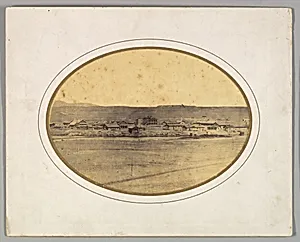
In 1866, Glover secured sponsorship from the Smithsonian Institution to accompany an Indian treaty commission to Fort Laramie, intending to create portraits of Native leaders and views of the landscape. He arrived in Omaha in May and proceeded westward, producing photographs such as the albumen silver print of Fort Laramie, Wyoming (ca. 1866), now in the Metropolitan Museum of Art.
Tragically, Glover was killed and scalped by hostile Sioux warriors on September 16, 1866, near Fort Phil Kearny in Wyoming while working on assignment. His death at age 35 cut short a promising effort to visually record Plains Indian life and frontier forts. Though few of his images survive in major collections, Glover’s work stands as an early, firsthand photographic record of the post-Civil War West, offering valuable historical insight into a rapidly changing landscape.