Ctrl K
1483–1561
Ridolfo Ghirlandaio, born Ridolfo di Domenico Bigordi on February 14, 1483, in Florence, emerged as a leading figure in the Florentine Renaissance painting tradition. The son of the renowned artist Domenico Ghirlandaio, he lost his father at age eleven in 1494 and was raised by his uncle Davide Ghirlandaio, who assumed leadership of the family workshop. Ridolfo trained initially under his father, followed by his uncles Benedetto and Davide, honing skills in portraiture and frescoes within the bustling Ghirlandaio studio. Giorgio Vasari records that he further studied under Fra Bartolomeo, whose influence is evident in his early compositions, blending his father's naturalistic precision with emerging High Renaissance monumentality.
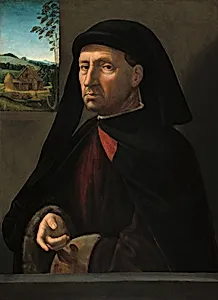
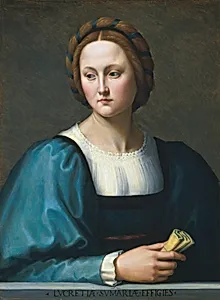
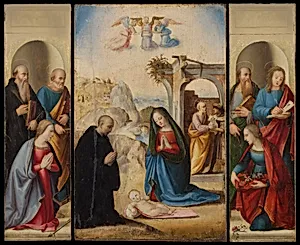
Ridolfo's style evolved through close friendships with Raphael—whom he assisted on works like the Louvre's *Virgin and Child with the Infant Saint John*—and admirers of Leonardo and Piero di Cosimo, resulting in luminous portraits and devotional scenes marked by graceful figures and detailed landscapes. His first documented commission, a *Virgin* for Prato Cathedral in 1507, showcased these traits, while masterpieces include the 1517 panels *Saint Zenobius Resuscitating a Child* and *Translation of the Body of Saint Zenobius* at Florence's Galleria dell'Accademia, and the *Procession to Calvary* (c. 1505), now in London's National Gallery. He excelled in public frescoes, such as those in Palazzo Vecchio (1514) depicting the Trinity and Annunciation, and altarpieces like the *Coronation of the Virgin* (1504, Avignon) and *Assumption of the Virgin* (1519–24, Berlin). Portraiture formed a cornerstone, with sensitive depictions like *Portrait of Girolamo Benivieni* (National Gallery) and *Portrait of a Nobleman of the Capponi Family* (c. 1555, Thyssen-Bornemisza).
Ridolfo led a thriving workshop training pupils like Michele Tosini, Domenico Puligo, and Pontormo, producing works for Medici events, including Pope Leo X's 1515 entry into Florence and Giuliano de' Medici's wedding decorations. Father to fifteen children, he amassed wealth through family trade and commissions, though gout plagued his later years; many final pieces were completed by Tosini. His legacy endures in surviving altarpieces, frescoes, and portraits across museums, bridging late Quattrocento realism with Cinquecento grace, ensuring the Ghirlandaio name's prominence in Florence.
All 3 artworks loaded