Ctrl K
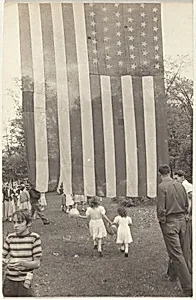
Robert Frank (1924-2019) was a Swiss-American photographer and documentary filmmaker whose revolutionary approach to documentary photography fundamentally transformed the medium and influenced generations of artists. Born in Zurich, Switzerland, on November 9, 1924, to a middle-class Jewish family, Frank began his photographic apprenticeship in 1941, working with commercial photographers before immigrating to the United States in 1947 at age 23. His seminal work, The Americans (1958), containing 83 black-and-white photographs taken during cross-country road trips funded by a Guggenheim Fellowship, challenged traditional photographic conventions and revealed an unflinching, poetic vision of American society marked by racial inequality, alienation, and the contradictions beneath the prosperous Eisenhower-era facade. Frank's spontaneous, emotionally charged style—characterized by tilted horizons, grainy exposures, unconventional compositions, and an emphasis on feeling over technical perfection—initially drew harsh criticism from the photography establishment but became a touchstone for subsequent generations of documentary and street photographers. By the late 1950s, Frank had begun transitioning to filmmaking, creating groundbreaking works like Pull My Daisy (1959) and the controversial documentary Cocksucker Blues (1972) about the Rolling Stones. His later career was profoundly shaped by personal tragedies: his daughter Andrea died in a plane crash in 1974, and his son Pablo, who struggled with schizophrenia, died by suicide in 1994. These losses infused his later work with themes of memory, loss, and grief. Frank divided his time between New York City and Mabou, Nova Scotia, where he lived with his second wife, sculptor June Leaf, from 1971 until his death. His influence on photography cannot be overstated—The Americans remains perhaps the most influential photobook of the 20th century, and his personal, confessional approach to image-making paved the way for photographers including Garry Winogrand, Lee Friedlander, Nan Goldin, and Danny Lyon. Frank's work is held in major collections worldwide, including the Museum of Modern Art, the Metropolitan Museum of Art, and the National Gallery of Art. He died on September 9, 2019, at his home in Nova Scotia, leaving behind a legacy as one of the most important and influential photographers and independent filmmakers of the 20th century.
Robert Frank was born on November 9, 1924, in Zurich, Switzerland, the second of two children to Rosa (Zucker) and Hermann Frank. His father, originally from Frankfurt, Germany, was a successful businessman and amateur photographer with an interest in art; his mother Regina came from a wealthy Basel factory-owning family. The family was Jewish, and though they remained safe in neutral Switzerland during World War II, the threat of Nazism profoundly affected Frank's understanding of oppression and outsider status. His father had become stateless after losing his German citizenship as a Jew, while his mother held a Swiss passport, requiring the family to apply for Swiss citizenship for Robert and his older brother Manfred. This experience of displacement and precarious identity would later inform Frank's empathetic outsider's perspective on American society.
Raised in comfortable, middle-class surroundings, Frank was an athletic youth who joined a boy scout troop and the Swiss Alpine Club. However, he turned to photography in part as a means to escape the confines of his business-oriented family and home. After graduating from high school, he began an apprenticeship in 1941 with Hermann Segesser, a photographer and retoucher who lived in the same apartment building as the Frank family. The following year, he began working for the Zurich commercial photographer Michael Wolgensinger, who introduced him to Switzerland's active magazine, newspaper, and book publishing industry. Frank spent the next six years working for commercial photography and graphic design studios in Zurich, Geneva, and Basel. He was particularly influenced by Swiss photographers Gotthard Schuh and especially Jakob Tuggener, whom Frank deeply admired as a serious artist who had left the commercial world behind. In 1946, Frank created his first hand-made book of photographs, 40 Fotos, demonstrating his early interest in the photobook form. By 1947, frustrated by the constraints of his homeland and eager for new experiences, the 23-year-old Frank left Switzerland and immigrated to the United States, where his career as a groundbreaking photographer would truly begin.
Soon after arriving in New York in 1947, Frank was hired by Alexey Brodovitch, the legendary art director of Harper's Bazaar, to make fashion photographs. Brodovitch, a Russian-born photographer and influential instructor, recognized Frank's talent and suggested he abandon the medium-format Rolleiflex camera he had been using for a 35mm Leica, arguing that the Leica could create more fluid, immediate images compared to the slower, bulkier Rolleiflex. This technical shift proved crucial to Frank's evolving artistic vision. In 1948, he traveled to Peru and Bolivia, making photographs with a newfound freedom. He later described his approach to the Peru photographs: 'I was very free with the camera. I didn't think of what would be the correct thing to do; I did what I felt good doing. I was like an action painter.' In March 1949, he mailed his mother in Switzerland a birthday gift—a maquette of photographs from his Peru journey, assembled as a handmade book titled Peru. An identical maquette he kept for himself; both now reside in the collections of the Museum of Modern Art, New York, and the National Gallery of Art, Washington.
Between 1949 and 1951, Frank worked in England, Wales, and France, continuing to develop his distinctive visual language. He married fellow artist Mary Lockspeiser, with whom he would have two children, Andrea (born 1950) and Pablo. During this period, Frank made friends with Walker Evans, the pioneering American photographer whose 1938 book American Photographs would profoundly influence Frank's work. Evans's impassive, 'Atget-like' approach to subjects contrasted with the more romantic visions endorsed by Edward Steichen, then director of photography at the Museum of Modern Art. Despite their different outlooks, Frank and Evans formed a close bond, and Frank learned from Evans to be more reflective when approaching his subject matter, though Frank ultimately shot more with emotion and instinct. In 1955, Frank achieved recognition when Steichen included seven of his photographs in the world-touring Museum of Modern Art exhibition The Family of Man, which would be seen by 9 million visitors. By this time, Frank had absorbed multiple influences—the documentary tradition of Evans, the editorial sophistication of Brodovitch, the artistic independence of Tuggener, and the spontaneous energy of the emerging Beat culture—all of which would converge in his most important work.
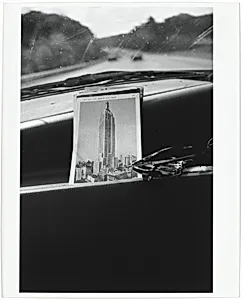
In the fall of 1954, Frank applied to the John Simon Guggenheim Memorial Foundation for a fellowship 'to photograph freely throughout the United States,' as he wrote in his application, seeking 'to make a broad, voluminous picture record of things American.' With letters of recommendation from Walker Evans, Edward Steichen, and Alexey Brodovitch, Frank was awarded the fellowship in spring 1955, becoming the first European photographer to receive this honor. He would receive a second Guggenheim Fellowship in 1956. With funding secured, Frank purchased a used Ford Business Coupe and, armed with his 35mm Leica camera with 35mm and 50mm lenses, embarked on a series of cross-country road trips covering approximately 10,000 miles across more than 30 states. Over these two years, sometimes traveling with his family, Frank took approximately 27,000 to 28,000 photographs, capturing what he described as a 'large order' of photographing America.
From this vast archive, Frank selected only 83 photographs for publication in what would become The Americans. The book was first published in France by Robert Delpire in 1958 as Les Américains, then in the United States by Grove Press in 1959 with an introduction by Jack Kerouac, the Beat poet and novelist whose prose style shared Frank's improvisational, anti-establishment sensibility. The images looked beneath the surface of American life to reveal a people plagued by racism, ill-served by their politicians, and rendered numb by a rapidly expanding culture of consumption. Yet Frank also found beauty in simple, overlooked corners of American life. His subject matter—cars, jukeboxes, flags, roadside diners, and the highway itself—combined with his seemingly intuitive, immediate, off-kilter style made The Americans profoundly innovative. The photography establishment responded with hostility; Popular Photography magazine derided the images as 'meaningless blur, grain, muddy exposures, drunken horizons, and general sloppiness.' First-year sales amounted to only 600 copies. However, for a younger generation of photographers, The Americans was a revelation. Frank's cutting perspective on American culture, combined with his carefree attitude toward traditional photographic technique—prioritizing emotion over technical perfection—challenged everything that conventional documentary photography represented. Critic Sean O'Hagan would later write in The Guardian that The Americans 'changed the nature of photography, what it could say and how it could say it... it remains perhaps the most influential photography book of the 20th century.' The book gained significant traction after 1968, becoming a bible for artists and securing Frank's place in photographic history.
By the time The Americans was published in the United States in 1959, Frank had already begun moving away from still photography to concentrate on filmmaking. That same year, he co-directed the experimental film Pull My Daisy with Alfred Leslie. Written and narrated by Jack Kerouac and starring Beat Generation figures including Allen Ginsberg and Gregory Corso, Pull My Daisy captured the spontaneous, improvisational spirit of the era and became a seminal work of American independent cinema. The film demonstrated Frank's ability to transfer his photographic sensibility—intimate, observational, anti-establishment—into moving images. New York Times film critic Manohla Dargis would later call Frank 'one of the most important and influential American independent filmmakers of the last half-century.'
Throughout the 1960s and early 1970s, Frank continued making films while occasionally returning to photography. With Allen Ginsberg's participation, he made Me and My Brother (1968), a documentary about poet Peter Orlovsky's institutionalized brother Julius, blending fiction and documentary in an innovative hybrid form. He also created Conversations in Vermont (1969) and About Me: A Musical (1971). Perhaps his most notorious film was Cocksucker Blues (1972), a raw documentary of the Rolling Stones' 1972 American tour showing the band engaging in heavy drug use and group sex. The Stones sued to prevent the film's release, disputing whether Frank as the artist or the Stones as those who hired him owned the copyright. A court order restricted the film to being shown no more than five times per year, and only in Frank's presence, giving it legendary status in underground cinema. During this period, Frank worked with screenwriter Rudy Wurlitzer on Keep Busy (1975) and Energy and How to Get It (1981). In 1961, Frank received his first individual photography show, Robert Frank: Photographer, at the Art Institute of Chicago, followed by an exhibition at the Museum of Modern Art in 1962, establishing his dual identity as both photographer and filmmaker.
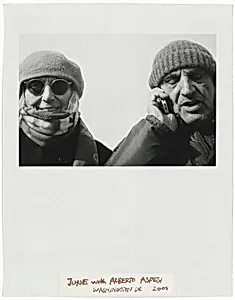
In 1969, Frank and his first wife Mary separated. He remarried sculptor June Leaf, and in 1971, the couple moved to the remote fishing community of Mabou on Cape Breton Island, Nova Scotia, Canada, seeking refuge in an old fisherman's cottage on the windswept coast. Frank divided his time between this isolated retreat and his Bleecker Street loft in New York City, acquiring a reputation as a recluse who declined most interviews and public appearances. Then, in 1974, devastating tragedy struck: his daughter Andrea was killed at age 20 in a plane crash in Tikal, Guatemala. Around the same time, his son Pablo was first hospitalized and diagnosed with schizophrenia. Frank was perpetually haunted by thoughts that he had in some way failed his children, having once admitted, 'it was very, very hard, almost impossible to live with me.'
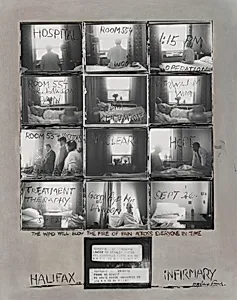
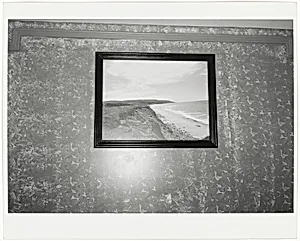
Much of Frank's subsequent work dealt directly with the impact of these losses. In the years following Andrea's death, he commemorated her by integrating her portrait into the surroundings where they last spent time together, in the landscape he viewed daily in Nova Scotia. His photography became increasingly personal, confessional, and experimental, incorporating text, photomontage, manipulation, and sequencing strategies that reflected his grief and introspection. While continuing to make films, Frank returned seriously to photography in the 1970s. In 1972, he had published The Lines of My Hand with Yugensha in Tokyo (later reissued by Lustrum Press in the US), a deeply personal photobook that proved even more influential than The Americans for some photographers. Structured chronologically, it presented selections from every stage of his work from 1945 to 1972—from early Swiss photographs to Peru, Paris, Valencia, London, Wales, contact sheets from The Americans journey, intimate photos of his young family, photo-collages, and film stills. The book included short personal texts like diary entries that brought his voice fully into the work. In its singular combination of text and image, fearless self-reflection, and insistence on photography and film as equal parts of his art, The Lines of My Hand inspired many photographers and pointed toward the direction Frank's work would take. In 1986, the Museum of Fine Arts, Houston organized the seminal exhibition Robert Frank: New York to Nova Scotia, featuring his photographs and films; the museum would eventually own more than 350 of Frank's photographs and the original maquettes for The Americans and The Lines of My Hand.
In 1994, Frank suffered another devastating loss when his son Pablo died by suicide at age 44 after years of struggling with mental illness. The following year, in memory of his daughter, Frank founded the Andrea Frank Foundation, which provides grants to artists. His later work became what critics described as 'alternately poignant, reflective, self-mocking and angry,' revealing Frank's late-career preoccupations with memory, mortality, and endurance. He continued working with filmmaker collaborators and created Candy Mountain (1987) and The Present (1996). In 1994, the National Gallery of Art in Washington, D.C. presented Moving Out, the most comprehensive retrospective of Frank's work to date. He was a recipient of the Principal Award at the 2009 Oberhausen Film Festival.
Throughout his final decades, Frank's influence only grew. His photographs were exhibited internationally at major venues including Les Rencontres d'Arles (2018), Albertina in Vienna (2018), Art Institute of Chicago (2017), Museum Folkwang in Essen (2014), and Tate Modern in London (2004). In 2015, Frank donated all of his unique film and video materials to the Museum of Modern Art's collection. With German publisher Gerhard Steidl, Frank organized a large touring exhibition titled Robert Frank: Books and Films 1947-2016, which included over one hundred photographs and several films, launching in New York in early 2016. His work is held in the permanent collections of the Metropolitan Museum of Art, the National Gallery of Art, the Kunsthaus Zurich, and numerous other major institutions worldwide. Frank died on September 9, 2019, at age 94, in a hospital near his home in Mabou, Nova Scotia. In 2024, on the centennial of his birth, the Museum of Modern Art presented Life Dances On: Robert Frank in Dialogue, his first solo exhibition at MoMA, featuring some 200 works made over 60 years and exploring the six vibrant decades of his career following The Americans. MoMA also presented a complete retrospective of his films and videos, cementing his legacy as a transformative figure in both photography and cinema.
Biography length: ~2,847 words