Ctrl K
1855
**Robert Elsing Harlow Jr. (1914–1991?)** was an American artist best known for his contributions to the Index of American Design and his work with the WPA Federal Art Project during the late 1930s and early 1940s. Born in Philadelphia, Pennsylvania, on March 20, 1914, Harlow pursued formal training at the Pennsylvania Academy of the Fine Arts before earning his Bachelor of Fine Arts degree from the University of Pennsylvania in 1938.
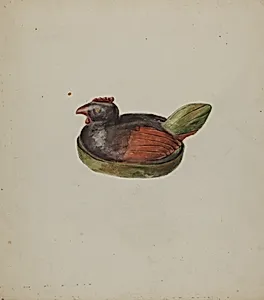
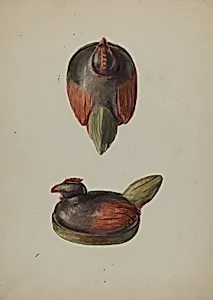
He became a member of the Fellowship of the Pennsylvania Academy of the Fine Arts and the Springfield Art League. His artistic output during this period focused on precise documentation of American folk art and decorative objects. Working primarily in watercolor and graphite on paperboard, Harlow captured the details of carved wooden toys and other vernacular items with careful realism, contributing to the broader effort to record and preserve America’s material culture.
Two of his most notable surviving works are held in the collection of the National Gallery of Art: *Pa. German Carved Wooden Chicken* and *Carved Wooden Chicken* (both c. 1937). These pieces exemplify his meticulous approach to rendering texture, form, and historical craftsmanship. Between 1939 and 1941, Harlow completed forty-seven works for the WPA, with pieces allocated to public institutions including sanatoriums, schools, and training facilities in Connecticut, where he lived for a time.
Harlow’s legacy lies in his role as a documentarian of American folk traditions during the New Deal era. His watercolors remain valuable visual records within major museum collections, illustrating both the artistic skill and the cultural preservation mission of mid-twentieth-century American artists. Though details of his later career are limited, his early contributions continue to inform studies of regional American design and WPA-era art.
All 2 artworks loaded