Ctrl K
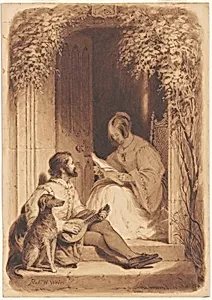
**Robert Walter Weir (1803–1889)** was a prominent American painter, educator, and key figure in the Hudson River School. Born in New York City on June 18, 1803, to Robert and Mary Katherine Brinckley Weir, he initially pursued a mercantile career before dedicating himself to art at age 18. Largely self-taught in his early years, Weir studied drawing and painting in New York from 1822 to 1824. He then traveled to Italy in 1824, where he studied in Florence under the Italian portraitist Pietro Benvenuti and later in Rome, immersing himself in the works of Renaissance masters such as Michelangelo and Raphael.
Weir returned to New York in 1827 and quickly became active in the city’s artistic circles. Elected to the National Academy of Design in 1829, he specialized in historical subjects, portraits, and landscapes rendered in a realistic style aligned with the Hudson River School. In 1834, he accepted the position of Teacher of Drawing at the United States Military Academy at West Point, advancing to Professor of Drawing in 1846 and serving until 1876—a remarkable 42-year tenure during which he instructed future Civil War leaders, including James Abbott McNeill Whistler and Ulysses S. Grant.
His most celebrated work is the monumental *Embarkation of the Pilgrims* (commissioned 1837; installed 1843–44), an oil-on-canvas painting measuring 12 by 18 feet that hangs in the United States Capitol rotunda. Other notable pieces include *Landing of Henry Hudson* (1835), *Saint Nicholas* (1837), and numerous portraits such as those of Robert E. Lee and Winfield Scott. Weir produced more than 450 known works, many of which were exhibited at the National Academy and reproduced in popular annuals.
Weir married twice and fathered 16 children, several of whom carried on his artistic legacy. His sons John Ferguson Weir and Julian Alden Weir both became accomplished painters and educators. Remembered as a versatile artist and influential teacher who bridged early American art traditions with the next generation, Weir died in New York City on May 1, 1889. His contributions to historical painting and art education helped shape 19th-century American visual culture.