
Ctrl K
1764–1849
Ruan Yuan (1764–1849), courtesy name Boyuan and art name Yuntai, was born on February 21, 1764, in Yizheng, Jiangsu province, into a distinguished Yangzhou family; his grandfather had served as Major General of Hunan. He received early instruction in Chinese characters from his mother at age five and in the Confucian classics from his father, later studying in Beijing around 1786 under disciples of the evidential scholar Dai Zhen, including Wang Niansun, Ren Dachun, and Shao Jinhan. After earning the jinshi degree in 1789, he entered the Hanlin Academy, where he contributed to catalogs of the imperial collections of painting and calligraphy.
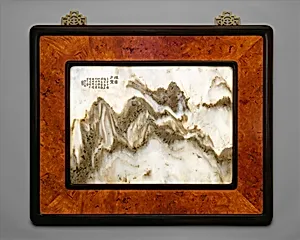
As a scholar-artist, Ruan Yuan excelled in calligraphy across seal, clerical, standard, and especially running scripts, drawing on ancient stone inscriptions and bronzes he examined while serving as education commissioner in Shandong. He authored the influential treatises *Nanbei shupai lun* (On the Southern and Northern Schools of Calligraphy) and *Beibei nantie lun* (On Northern Steles and Southern Model Calligraphy), which distinguished the vigorous Northern stele school (beixue) from the elegant Southern model-letter tradition (tiexue) and advocated studying Han and Wei dynasty monuments. While posted in Yunnan, he pioneered “stone paintings” (shihua) by selecting, polishing, and framing Dali marble slabs whose natural markings evoked misty landscapes, inscribing them with poems, and documenting the practice in his *Shihua ji*.
Ruan Yuan’s distinguished official career included posts as education commissioner in Shandong and Zhejiang, governor of several provinces, Viceroy of Liangguang from 1817 to 1826, and Grand Secretary. A leading figure of the Qian-Jia school of evidential scholarship (kaozheng) and Han Learning, he founded academies such as the Gujing jingshe in Hangzhou and the Xuehaitang in Guangzhou to promote classical studies. His major scholarly publications include the *Chouren zhuan* (Biographies of Astronomers and Mathematicians, 1799) and a critical edition of the *Shisan jing zhushu* (Commentaries and Notes on the Thirteen Classics).
Ruan Yuan’s legacy as an honest Confucian official, prolific scholar, and patron of learning endures through his academies, publications still reprinted today, and artistic contributions that influenced the later stele school of calligraphy. Surviving examples of his inscribed stone paintings and calligraphic works, including pieces in the Metropolitan Museum of Art, illustrate the literati fusion of scholarship and aesthetic appreciation. He retired to Yangzhou and died there on November 27, 1849, widely regarded as the most prominent Chinese scholar of the first half of the nineteenth century.
All 1 artworks loaded