Ctrl K
1577–1640
Movements
Occupations
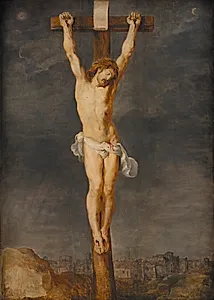
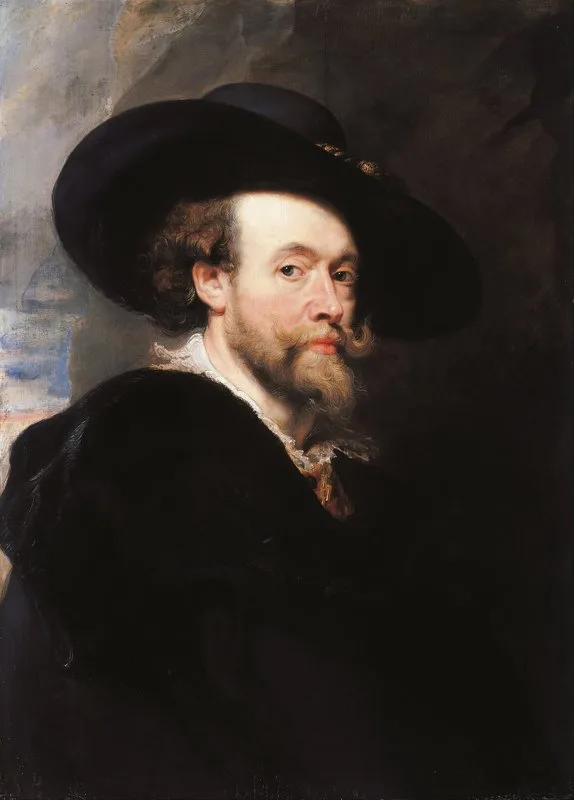
Peter Paul Rubens (1577-1640) stands as the most influential artist of the Flemish Baroque tradition and the greatest exponent of Baroque painting's dynamism, vitality, and sensuous exuberance. Born in Siegen, Westphalia, and raised in Antwerp, Rubens received a humanist education studying Latin and classical literature before pursuing artistic training under three masters: Tobias Verhaecht, Adam van Noort, and Otto van Veen. His formative years culminated in becoming an independent master in the Guild of St. Luke in 1598. Rubens's transformative eight-year sojourn in Italy (1600-1608) profoundly shaped his artistic vision. Serving at the court of Duke Vincenzo I Gonzaga in Mantua, he traveled extensively throughout Italy, absorbing the coloristic brilliance of Venetian masters Titian, Veronese, and Tintoretto, while studying the naturalistic innovations of Caravaggio and the monumental forms of Michelangelo and Raphael. This Italian experience forged his unique synthesis of Flemish realism and Italian Renaissance grandeur. Returning to Antwerp in 1608, Rubens became court painter to the Spanish governors of Flanders and established a prolific workshop that produced over 1,400 works. His unique Baroque style emphasized dramatic movement, bold color, sensuous forms, and theatrical lighting, epitomizing Counter-Reformation religious art while also excelling in mythology, history, portraiture, and landscape. Beyond painting, Rubens served as a diplomat for European courts, receiving knighthoods from both Philip IV of Spain and Charles I of England. His influence extended across three centuries, profoundly impacting artists from Anthony van Dyck to Pierre-Auguste Renoir, and fundamentally shaping the development of European art through the Rococo, Romantic, and Impressionist movements.
Peter Paul Rubens was born on June 28, 1577, in Siegen, Nassau, Westphalia (modern-day Germany), to Jan Rubens, a Calvinist lawyer, and Maria Pypelincks. His family had fled Antwerp for Cologne in 1568 due to religious persecution during the Duke of Alba's rule over the Spanish Netherlands. Following his father's death in 1587, the family returned to Antwerp, where young Peter Paul was raised in his mother's Roman Catholic faith and received a Classical humanist education, studying Latin and classical literature.
At age fourteen in 1591, Rubens began his artistic apprenticeship with Tobias Verhaecht, a kinsman and landscape painter. A year later, he moved to the studio of Adam van Noort, a specialist in figure drawing and history painting, where he spent four years honing skills in anatomy and composition. From 1594 to 1598, he trained under Antwerp's leading artist, Otto van Veen, dean of the painters' guild of St. Luke. Van Veen, a Romanist painter, imbued Rubens with a lively sense of painting as a lofty humanistic profession and provided the intellectual and artistic stimulation that suited his temperament. Rubens also studied the woodcut works of Hans Holbein the Younger and the engravings of Marcantonio. In 1598, at age twenty-one, he was admitted as an independent master to the Guild of St. Luke in Antwerp, marking the completion of his formal training.
In May 1600, the ambitious twenty-two-year-old Rubens embarked for Italy, eager to study the works of ancient and modern masters firsthand. He stopped first in Venice, where he encountered the paintings of Titian, Veronese, and Tintoretto, whose vibrant coloring and dynamic compositions had an immediate and lasting effect on his artistic development. He then settled in Mantua at the court of Duke Vincenzo I Gonzaga, a renowned art collector with a rich collection of Italian Renaissance masterpieces. For the next eight years, Rubens served the Duke while traveling extensively throughout Italy, carrying out commissions in Mantua, Rome, Genoa, and even traveling to Spain as Gonzaga's envoy.
With the Duke's financial support, Rubens traveled to Rome by way of Florence in 1601, where he studied classical Greek and Roman art and copied works of the Italian masters. The Hellenistic sculpture Laocoön and His Sons profoundly influenced him, as did the art of Michelangelo, Raphael, and Leonardo da Vinci. In Rome, he came under the spell of the new Baroque style heralded by Annibale Carracci and the highly naturalistic paintings of Caravaggio. He later made a copy of Caravaggio's Entombment of Christ and recommended The Death of the Virgin to the Duke of Mantua. During this period, Rubens built a network of friendships with important figures including the scientist Galileo Galilei. From 1606 to 1608, he was largely in Rome, receiving his most important commission to date for the high altar of Santa Maria in Vallicella (Chiesa Nuova). Upon hearing of his mother's illness in 1608, Rubens departed for Antwerp, though she died before he arrived. This immersive Italian experience had a profound impact on his art, and he continued to correspond with Italian friends, signed his name as 'Pietro Paolo Rubens,' and spoke longingly of returning to the peninsula, though this wish never materialized.
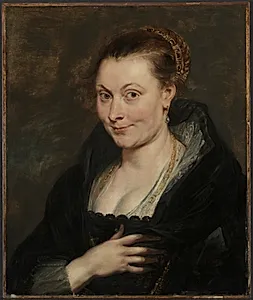
Returning to Antwerp in 1608, Rubens quickly established himself as the city's preeminent painter. He became court painter to the Spanish governors of Flanders, Albert and Isabella, exempted from all taxes, guild restrictions, and official duties in Brussels, allowing him to remain in Antwerp and organize his own studio. In October 1609, he married the nineteen-year-old Isabella Brant. In 1610, Rubens moved into a new house and studio of his own design, an Italian-influenced villa in the center of Antwerp (now the Rubenshuis Museum) that accommodated his workshop, personal art collection, and library, both among the most extensive in the city.
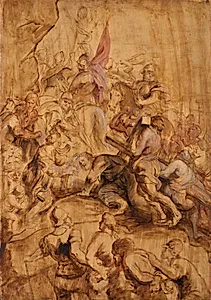
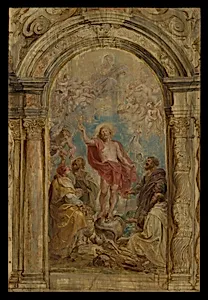
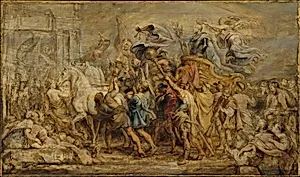
Rubens organized a large workshop of pupils and assistants to manage his extraordinary output of religious pictures, history paintings, portraits, and mythological scenes. From the outset, he oversaw a stable of able collaborators for executing his vast-scale paintings. Altarpieces such as The Raising of the Cross (1610) and The Descent from the Cross (1611-1614) for the Cathedral of Our Lady in Antwerp were particularly important in establishing Rubens as Flanders' leading painter. The Raising of the Cross demonstrates his synthesis of Tintoretto's dynamic compositions, Michelangelo's powerful figures, and his own personal style, becoming a prime example of Baroque religious art. His most talented assistant was the young Anthony van Dyck, whom Rubens called 'the best of my pupils.' Van Dyck arrived at his studio as an apprentice around 1616 and stayed for four years, quickly absorbing Rubens's robust style. In 1621, Queen Mother of France Marie de' Medici commissioned Rubens to paint two large allegorical cycles celebrating her life and that of her late husband Henry IV for the Luxembourg Palace in Paris. The Marie de' Medici cycle (now in the Louvre) was installed in 1625, showcasing Rubens's mastery of grand historical allegory.
In 1626, Rubens's domestic happiness was shattered by the death of his wife, Isabella. He soon embarked on a diplomatic odyssey seeking peace between England and Spain, leveraging his artistic reputation and courtly connections in service of European politics. His diplomatic missions took him to Madrid, London, and other European capitals, where he negotiated treaties while continuing to paint. In recognition of his dual achievements, Rubens was knighted by both Philip IV of Spain in 1624 and Charles I of England in 1630, the only painter so honored by the kings of both nations.
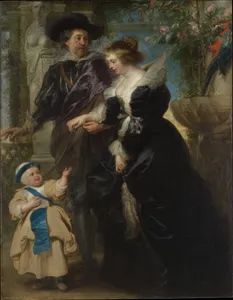
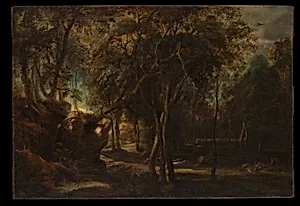
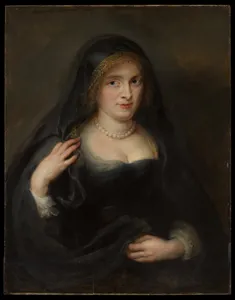
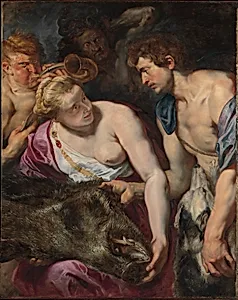
In December 1630, the fifty-three-year-old Rubens married the sixteen-year-old Helena Fourment, youngest daughter of the silk and tapestry merchant Daniel Fourment. Helena inspired some of the most personal and intimate portraits of Rubens's later career, including tender domestic scenes and sensuous mythological works. Their marriage produced five children and brought renewed happiness to his later years. In 1635, Rubens purchased an estate outside Antwerp, the Chateau de Steen (Het Steen), where he spent increasing time creating landscape paintings that reflected a more contemplative mood. These late landscapes reveal a different aspect of his genius, celebrating the Flemish countryside with atmospheric subtlety and naturalistic observation. Rubens continued working prolifically until his death from gout on May 30, 1640, at age sixty-two. He was interred in Saint Jacob's church in Antwerp, leaving behind a body of work comprising over 1,400 pieces and an artistic legacy that would profoundly influence European painting for centuries.
Artheon Research Team
Last updated: 2025-11-28
Biography length: ~1,247 words
Wikidata/Wikimedia Commons