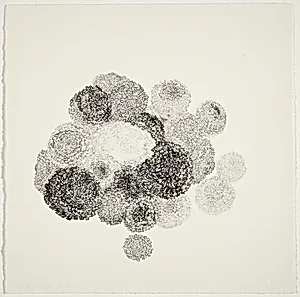
Ruth Asawa (1926–2013), born Ruth Aiko Asawa in Norwalk, California, as the fourth of seven children to Japanese immigrant farmers Umakichi and Haru Asawa, grew up on a truck farm where she honed her artistic eye sketching natural forms in the sand. During World War II, her family endured separation under Japanese American internment; while most were held at Rohwer Relocation Center in Arkansas—where Asawa completed high school and studied drawing under camp illustrators—her father was detained in New Mexico. Denied a teaching degree at Milwaukee State Teachers College due to anti-Japanese discrimination (retroactively awarded in 1998), she thrived at Black Mountain College from 1946 to 1949, studying under luminaries like Josef Albers, Buckminster Fuller, Merce Cunningham, John Cage, Ilya Bolotowsky, and Jacob Lawrence in an experimental, interdisciplinary environment that emphasized process over product.
Asawa's signature style emerged from a pivotal 1947 trip to Toluca, Mexico, where she learned looped-wire crocheting from local artisans while teaching art to children; adapting this technique with galvanized wire, she created translucent, biomorphic sculptures evoking organic forms like cocoons, branches, and cellular structures—transparent volumes that play with light, shadow, and interior-exterior space. Influenced by Albers's focus on line and pattern, Black Mountain's dance and design ethos, and nature's repetitions, her modernist works bridged craft and fine art, later evolving into tied-wire branching forms (1960s) and electroplated pieces with patinated textures. Key early sculptures include *Untitled (S.401, Hanging Seven-Lobed, Continuous Interlocking Form, with Spheres within Two Lobes)* (c. 1953–1954) and *Untitled (S.449, Hanging Three Lobed Form with Stripes and Two Interior Spheres)* (c. 1958), now in major collections.
In the 1960s–1980s, Asawa turned to public commissions, earning the moniker "fountain lady" for interactive works like the controversial *Andrea* (1966–1968) at Ghirardelli Square—a bronze mermaid nursing her child amid sea creatures—and the community-involved *San Francisco Fountain* (1973) at Union Square, where schoolchildren molded city motifs in baker's clay for casting. Other landmarks include *Origami Fountains* (1976) and *Aurora* (1986) in San Francisco.
Married to architect Albert Lanier in 1949, Asawa raised six children—twins Xavier and Aiko (1950), Hudson (1952), Adam (1956–2003), Addie (1958), and Paul (1959)—in San Francisco's Noe Valley, balancing motherhood with artmaking. Her legacy as an arts advocate endures through co-founding the Alvarado Arts Workshop (1968) and inspiring the Ruth Asawa San Francisco School of the Arts (1982, renamed 2010), championing hands-on creativity for all. Retrospectives like *Ruth Asawa: A Retrospective* (2025–2027) affirm her enduring influence on sculpture, public art, and education.