Ctrl K
1814–1862
Samuel Colt was born on July 19, 1814, in Hartford, Connecticut, to Christopher Colt, a textile manufacturer, and Sarah Caldwell. His early years were marked by family tragedy, including the death of his mother from tuberculosis when he was six, after which his father remarried. At age 11, Colt was indentured to a farmer and later worked in his father's textile mill in Ware, Massachusetts, where he gained practical mechanical skills and access to tools. Inspired by a scientific encyclopedia and tales of inventors like Robert Fulton, the young Colt experimented with explosives and, at 16, went to sea aboard the brig Corvo. There, observing the ratchet mechanism of a ship's windlass, he carved a wooden prototype of a revolving-cylinder firearm from scrap wood. He received no formal artistic training, instead developing as a self-taught inventor and designer through hands-on experience and public demonstrations.
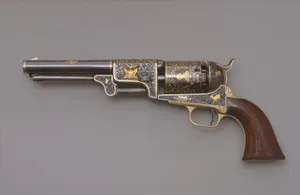
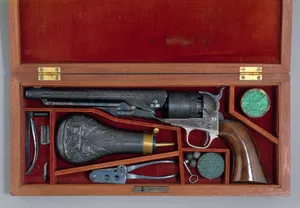
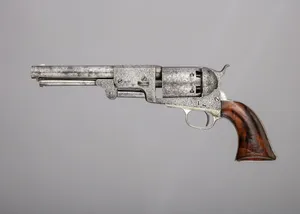
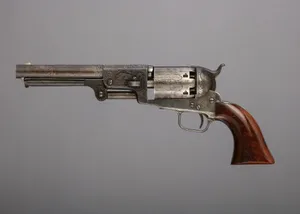
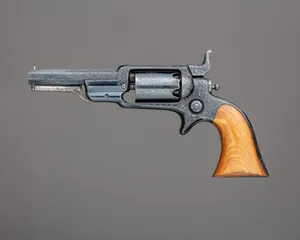
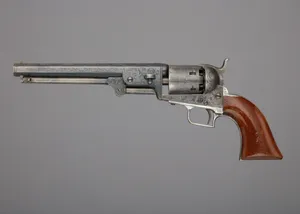
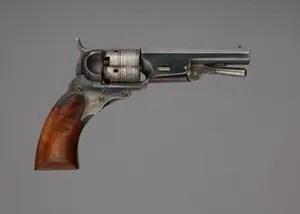
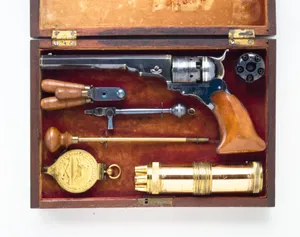
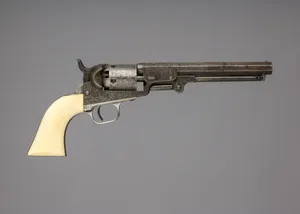
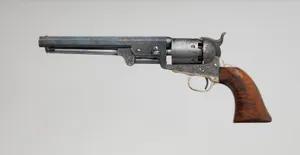
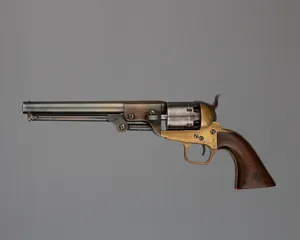
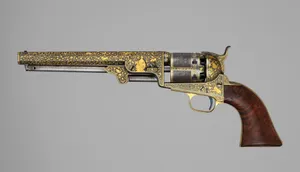
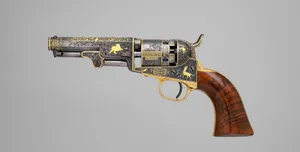
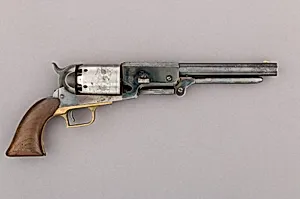
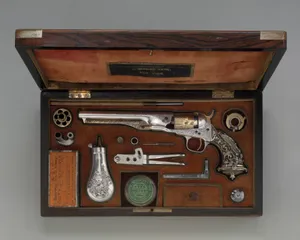
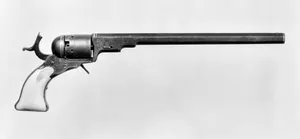
Colt's breakthrough came with his patented revolver design, first secured in Britain in 1835 and in the United States in 1836 (U.S. Patent 9430X). His earliest major work, the Colt Paterson revolver of 1836–1842, produced at his factory in Paterson, New Jersey, featured a five-shot rotating cylinder that allowed multiple firings without reloading—an innovation that redefined handgun architecture with clean, symmetrical lines and interchangeable parts. After initial business failures, success arrived with the 1847 Walker Colt and subsequent models like the Third Model Dragoon percussion revolver around 1853, often lavishly engraved and cased as presentation pieces. These firearms, treated as both functional tools and sculptural objects of industrial design, blended precision engineering with aesthetic appeal, including attractive finishes that made them instantly recognizable. Colt also commissioned promotional art, partnering with sculptor Hiram Powers for theatrical wax figures and paintings based on Dante's *Divine Comedy* during his early laughing-gas lecture tours, and later with painter George Catlin for a series of ten paintings (six reproduced as lithographs in 1855) depicting the artist using Colt revolvers in exotic settings.
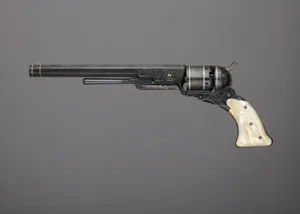
In 1855, Colt opened his massive Hartford armory, employing assembly-line techniques that pioneered mass production and interchangeable parts, producing up to 150 weapons daily by 1856. His designs, such as the Number 5 Holster or Texas Paterson pistol of 1840, exemplified a style of functional elegance that influenced American industrial aesthetics. He died on January 10, 1862, at age 47, one of the wealthiest men in the United States, leaving a factory that supplied both sides of the Civil War and later the American West. His widow, Elizabeth Hart Jarvis Colt, whom he married in 1856, became a major art collector and philanthropist, bequeathing significant holdings—including firearms, paintings, and decorative objects—to institutions like the Wadsworth Atheneum. Colt's legacy endures as a master of industrial design whose revolvers, now prized in museum collections as artworks of invention and craftsmanship, transformed manufacturing, advertising (through celebrity endorsements and branded imagery like the Rampant Colt statue), and the very form of the modern firearm.