Ctrl K
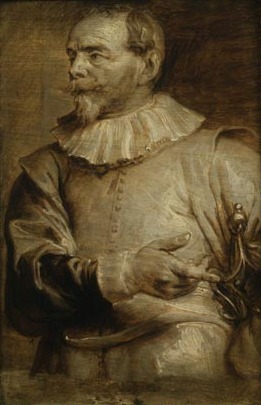
1573–1647
Sebastiaen Vrancx (1573–1647) was a pioneering Flemish Baroque painter, draughtsman, and print designer who fundamentally transformed Northern European art through his innovative approach to battle scene painting. Baptized in Antwerp's Sint-Jacobskerk on January 22, 1573, and dying in the same city on May 19, 1647, Vrancx lived through one of the most tumultuous periods in Netherlandish history—the Eighty Years' War and the division of the Netherlands into the Protestant Dutch Republic and the Catholic Spanish Netherlands. This context of nearly continuous warfare profoundly shaped his artistic vision and led him to pioneer the battle scene as an independent genre in Flemish painting. Vrancx was probably the first artist in the Northern or Southern Netherlands to create dedicated depictions of battle scenes as primary subjects rather than mere backgrounds to historical or biblical narratives. This innovation was likely inspired by his membership in Antwerp's civic guard (schutterij) from 1613 and his participation in the fencers' guild, which gave him direct knowledge of military culture, weaponry, and the realities of armed conflict. His battle paintings—characterized by dynamic compositions, careful attention to period-accurate military detail, and atmospheric effects—established a new genre that would influence European military painting for generations. Beyond battle scenes, Vrancx demonstrated remarkable versatility, creating landscapes with mythological and religious subjects, allegories of the seasons and months, city views, banquet scenes, village festivals, and genre subjects. His successful career included leadership positions in Antwerp's artistic community: admission to the painters' Guild of Saint Luke around 1600-1601, membership in the elite Romanist society (1610), and election as dean of the painters' chamber in 1611. His involvement in Antwerp's chamber of rhetoric "de Violieren" (1607) and his friendships with humanist scholars demonstrate his integration into the city's intellectual life. Works by Vrancx are held in major museums worldwide, including the Hermitage, Kunsthistorisches Museum, Louvre, Metropolitan Museum, and Museo del Prado, testament to his enduring significance in Baroque art.
Sebastiaen Vrancx was baptized on January 22, 1573, in Antwerp's prestigious Sint-Jacobskerk, the church that would later house works by Rubens and serve as his burial place. He was born to Jan Vrancx, a merchant, and Barbara Coutereau, placing him within Antwerp's prosperous mercantile class.
Antwerp in the 1570s was experiencing profound upheaval. The city had been at the center of the Dutch Revolt against Spanish rule, and would endure the catastrophic Spanish Sack of Antwerp in 1576 (the "Spanish Fury") when Vrancx was just three years old. These violent events during his childhood would have profound impact on his later artistic focus on military subjects.
According to Karel van Mander, the invaluable early biographer of Netherlandish artists, Vrancx received his training with Adam van Noort (1562–1641), who was also the master of both Rubens and Jordaens. However, art historians have noted that Vrancx's early style shows stronger affinities with artists like Cornelis Floris and Cornelis de Vos, suggesting his artistic formation drew on multiple sources.
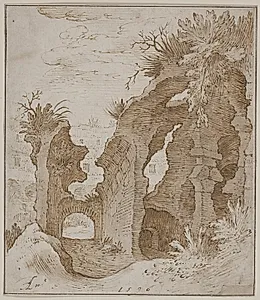
A drawing of the Colosseum dated 1596 provides the earliest concrete evidence of Vrancx's presence in Rome. Like many Northern European artists, Vrancx undertook the journey to Italy to study classical antiquity and Renaissance masters. This Italian journey was essential for an ambitious artist seeking to compete at the highest levels of artistic production.
Around 1600-1601, Vrancx was admitted to the painters' Guild of Saint Luke in Antwerp, the essential professional organization for artists in the city. Guild membership was required to practice professionally, and it provided access to the commercial networks and legal protections necessary for a successful career.
In 1607, Vrancx joined the chamber of rhetoric known as "de Violieren" (The Gillyflowers), one of Antwerp's prestigious literary and dramatic societies. These chambers combined theatrical performance, poetry, intellectual discussion, and festive celebration. Vrancx's membership demonstrates his integration into Antwerp's cultivated circles beyond purely artistic contexts.
A particularly significant honor came in 1610 when Vrancx was invited to join the elite "Confrerie of Romanists" (Liefde boven al/Love Above All), a society of Antwerp humanists and artists. Membership was conditional on having traveled to Rome, which Vrancx had done around 1596. The Romanists represented the most intellectually and culturally ambitious stratum of Antwerp's artistic community.
In 1611, Vrancx achieved one of the highest honors available to an Antwerp painter: election as dean of the painters' chamber of the Guild of Saint Luke. This position placed him at the apex of the city's artistic hierarchy and involved adjudicating disputes, maintaining quality standards, and representing painters' interests.
During these years, Vrancx was developing his distinctive approach to battle scenes. While military subjects had appeared in earlier Netherlandish art, they typically served as backgrounds or contexts for historical or religious narratives. Vrancx pioneered making battle scenes autonomous subjects, worthy of artistic attention for their own dramatic and compositional possibilities.
On July 7, 1612, Vrancx married Maria Pamphi, the daughter of an art dealer. This marriage connected him to Antwerp's art market infrastructure, potentially facilitating sales and commissions. The couple would have a daughter, though both Maria and their daughter predeceased Vrancx, dying together in 1639.
From 1613 onward, Vrancx served as a member of Antwerp's civic guard (schutterij) and participated in the fencers' guild. These military involvements were crucial to his development as a battle painter. Unlike artists who imagined military subjects from literary descriptions or second-hand accounts, Vrancx had direct experience with weapons, military formations, and martial culture.
The Twelve Years' Truce (1609–1621) had temporarily halted the Eighty Years' War between Spain and the Dutch Republic, but military culture remained central to Netherlands life. Civic guards continued training and ceremonial functions, providing Vrancx ongoing contact with military subjects.
Vrancx's battle paintings from this period demonstrate sophisticated understanding of cavalry tactics, weaponry, armor, and the chaotic dynamics of combat. Works like the "Battle near Vught" (1601, Koninklijk Museum voor Schone Kunsten, Antwerp) show cavalry engagements with careful attention to the realistic portrayal of horses, riders, weapons, and uniforms.
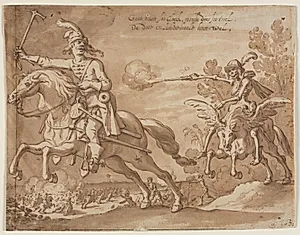
His representations pioneered several characteristics that would become standard in military painting: dynamic diagonal compositions suggesting movement and chaos; atmospheric effects including smoke and dust; careful rendering of period-accurate military equipment; and the combination of overall battlefield drama with vignettes of individual combat.
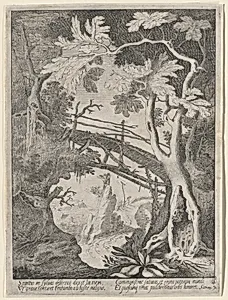
Beyond battle scenes, Vrancx produced diverse subjects during these years. He created landscapes with mythological subjects, allegories of seasons and months, scenes with robbers and bandits, village festivals, and city views. This versatility demonstrated his technical range and commercial acumen.
As Vrancx entered his sixties, he had established himself as Antwerp's preeminent battle painter while maintaining production across various genres. His reputation extended beyond Antwerp to international collectors and patrons.
The resumption of the Eighty Years' War after the Twelve Years' Truce (1621) and the concurrent Thirty Years' War (1618–1648) ravaging Central Europe ensured continued demand for military subjects. Vrancx's battle scenes found ready audiences among military officers, civic authorities, and collectors interested in contemporary conflicts.
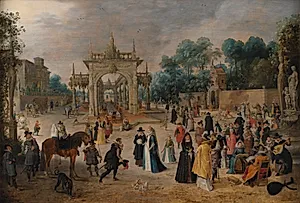
Vrancx also produced banquet scenes and genre subjects that demonstrated his ability to depict social gatherings with the same attention to detail and compositional sophistication he brought to battle scenes. These works combined careful observation of contemporary costume, furnishings, and social rituals with pleasing compositional arrangements.
The year 1639 brought personal tragedy when Vrancx's wife Maria and their daughter both died. After thirty-seven years of marriage, Vrancx found himself alone. The specific circumstances of their deaths—whether from disease, childbirth complications, or other causes—are not recorded, but the simultaneous loss suggests epidemic illness as a possible cause.
Despite this personal loss, Vrancx continued working through his final years. His late works maintained the technical quality and compositional sophistication that had characterized his career, though documentation of specific works from this period is limited.
Sebastiaen Vrancx died on May 19, 1647, in Antwerp, the city where he had been baptized seventy-four years earlier. His death came just one year before the Peace of Westphalia would end both the Eighty Years' War and the Thirty Years' War, conflicts that had defined the era in which he lived and worked.
Artheon Research Team
Last updated: 2025-11-09
Biography length: ~1,720 words