
Ctrl K
1534–1566
**Sekishō Shōan (石樵昌安, 1534–1566)** was a Japanese painter active during the late Muromachi period (1392–1573). Little is documented about his personal life or early training, yet the seals on roughly a dozen surviving works firmly link him to the emerging Kano school. He appears to have worked not in the main Kyoto lineage but in an eastern branch of the studio based in Odawara, near the historic city of Kamakura.
Shōan’s paintings reflect a distinctive fusion of influences. He drew on the refined brushwork and compositional clarity of Kano Motonobu (1476–1559), the school’s second-generation leader, while also incorporating the bolder, more atmospheric ink traditions long practiced in eastern Japan. His style is characterized by fluid ink washes, selective use of color and gold, and a sensitivity to landscape elements that evoke both Zen subjects and the rugged terrain of the region.
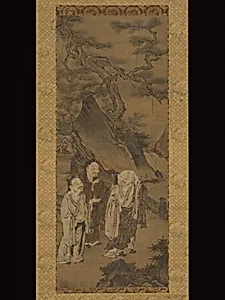
The sole work by Shōan in the virtual museum’s collection is the hanging scroll *Three Laughers of Tiger Ravine* (mid-16th century), now in the Metropolitan Museum of Art. Executed in ink, color, and gold on silk, it depicts the legendary encounter of the Buddhist monk Huiyuan, the Daoist Lu Xiujing, and the poet Tao Qian. The trio, caught laughing after inadvertently crossing a sacred boundary, occupies the lower register beneath a gnarled pine and rocky outcrop, embodying the syncretic spirit of Daoism, Buddhism, and Confucianism that resonated in Muromachi Japan.
Although biographical details remain elusive, Shōan’s modest surviving oeuvre places him among the lesser-known but significant figures of the Odawara Kano circle—artists such as Maejima Sōyū and Uto Gyoshi—who helped extend the school’s reach beyond the capital. His work bridges the classical Kano manner with regional eastern Japanese traditions, offering valuable insight into the diversity of ink painting during a pivotal era of Japanese art history.