
Ctrl K
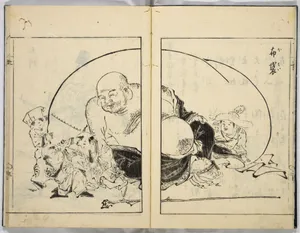
Sesshosai, also known as Terai Shigefusa, was a Japanese artist active during the mid-to-late Edo period, primarily in Osaka. His career spanned from the late 1740s into the 1780s, a time when woodblock printing flourished as a popular medium for illustrated books and ukiyo-e imagery. Little is recorded about his early life or formal training, but he emerged as a skilled designer of printed volumes that captured everyday subjects with elegance and precision.
Sesshosai worked firmly within the tradition of Edo-period woodblock books, producing detailed ink illustrations on paper that blended observational naturalism with decorative flair. His output focused on ehon, or picture books, which served both as artistic statements and accessible entertainment or reference works for a growing urban audience. One of his most notable contributions is the three-volume set *Ehon shūyō* (Picture Book of Collected Leaves, also translated as *A Collection of Sketches*), published in 1751. This work features a wide array of motifs—including flora, fauna, and landscapes—rendered through intricate woodblock techniques that highlight subtle textures and compositions.
Beyond this signature publication, Sesshosai continued creating similar illustrated books into later decades, contributing to the rich visual culture of Osaka printmaking. His designs reflect the broader ukiyo-e emphasis on capturing the transient beauty of the world, though his focus remained on printed books rather than single-sheet prints. Today, examples of his work are preserved in major collections such as the Metropolitan Museum of Art and the Victoria and Albert Museum, underscoring his role in preserving and disseminating Japanese artistic traditions through the reproducible medium of woodblock printing. His legacy endures as a representative figure of 18th-century Osaka book illustration, valued for its technical refinement and quiet observational charm.