
Ctrl K
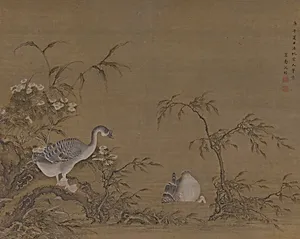
**Shen Kai** (active mid-18th century) was a Chinese painter of the Qing dynasty (1644–1911), renowned for his bird-and-flower compositions that evoked the refined elegance of earlier traditions. Working under the studio name Shaonan (or Tiao'nan) Shen Kai (苕南沈楷), he signed his works with seals such as "Shen Song Kai yin" (沈宋楷印) and "Ze An," reflecting a scholarly persona tied to poetic retreat and natural harmony. His early life and training remain not well documented, with no records of specific teachers or formal academies, though his style clearly drew from the meticulous techniques of Northern Song dynasty masters.
Shen Kai specialized in lyrical depictions of nature, blending vivid realism with subtle lyricism in ink and color on silk. His masterpiece, *Geese on a Riverbank* (1750), a hanging scroll measuring 77 × 96 cm, captures two wild geese amid reeds, chrysanthemums, and willow branches on a misty riverbank. Inscribed "On a summer day in the Gengwu year [1750], imitating the Northern Song painterly idea," the work showcases brilliant feather colors contrasting with delicate ink washes, symbolizing seasonal transience and contemplative withdrawal. Auction records reveal similar paintings, such as another rendition of geese on a pond, fetching significant prices and confirming his market appeal into modern times.
Though sparsely represented in major collections, Shen Kai's contributions endure through pieces like *Geese on a Riverbank* in the Art Institute of Chicago, acquired via Japanese provenance at the Qing's end. His ability to merge technical virtuosity—fine brushstrokes on plumage with atmospheric depth—revived Song-era ideals amid Qing eclecticism, influencing later admirers of literati painting. Today, his auction successes, reaching nearly $10,000 USD, underscore a legacy of understated poetic beauty in Chinese art history.