Ctrl K
1589–1631
Sinibaldo Scorza (1589–1631) was an Italian painter, draughtsman, and etcher who specialized in naturalistic landscapes populated with animals, biblical and mythological subjects. Born on July 16, 1589, into a wealthy aristocratic family in Voltaggio (near Genoa), Scorza received both a humanist education befitting his noble status and rigorous artistic training under Giovanni Battista Paggi in Genoa. His work demonstrates the influence of Flemish landscape and animal painters whose works he encountered in the cosmopolitan port city of Genoa. Scorza's career took him from Genoa to the court of Duke Carlo Emmanuele of Savoy in Turin (1619–1625), where he served as court painter. However, when war erupted between Genoa and Savoy in 1625, Scorza's position became untenable. He returned to Genoa under charges of treason, and though he briefly visited Rome in 1626, he spent his final years back in Genoa. During this late period, he may have taught the young Giovanni Benedetto Castiglione, and he took up etching shortly before his death on April 5, 1631.
Born on July 16, 1589, into a wealthy aristocratic family in Voltaggio (now part of Piedmont), Sinibaldo Scorza was the son of the Conte Scorza di Voltaggio. His privileged background provided him with a literary and humanist education unusual for a practicing artist.
In 1604, at age fifteen, Scorza entered the studio of Giovanni Battista Paggi in Genoa, where he received professional artistic training. Genoa's position as a major Mediterranean port meant that Scorza could study works by Flemish painters, which profoundly influenced his specialization in naturalistic landscapes with animals.
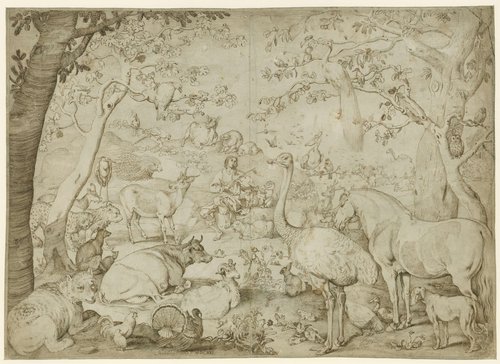
As an independent master, Scorza made a specialty of small canvases depicting biblical or mythological scenes, often crowded with animals. His painting 'Orpheus Singing to the Animals' became particularly popular and is known in several versions.
His work demonstrated sophisticated engagement with both Northern European naturalism and Italian compositional traditions, creating a distinctive synthesis well-suited to the tastes of Genoese collectors.
Between 1619 and 1625, Scorza worked in Turin as court painter to Carlo Emmanuele, Duke of Savoy. This prestigious position connected him to one of the most important courts in northern Italy.
During his years in Turin, Scorza created works for the ducal collection, applying his characteristic approach to animal and landscape painting to subjects appropriate for courtly patronage.
When war broke out between Genoa and Savoy in 1625, Scorza's position as a Genoese artist serving the Duke of Savoy became politically impossible. He returned to Genoa disgraced and faced charges of treason for having served Genoa's enemy.
In 1626, Scorza made a brief visit to Rome, exposing himself to the artistic developments in the papal capital. However, he returned in 1627 to Genoa, where he may have taken over Paggi's workshop after the master's death.
During this final Genoese period between 1627 and his death in 1631, Scorza took up the practice of etching, adding printmaking to his accomplishments in painting and drawing.
It is also during these final years that Scorza may have taught the young Giovanni Benedetto Castiglione, who would become the greatest Genoese painter of animals and pastoral scenes in the next generation, suggesting Scorza's influence extended beyond his own production.
Sinibaldo Scorza died on April 5, 1631, in Genoa, at age forty-one.
Artheon Research Team
Last updated: 2025-11-09
Biography length: ~487 words
All 3 artworks loaded