Ctrl K
Sir Edwin Henry Landseer RA was born on 7 March 1802 in London, England, the son of the engraver John Landseer A.R.A. and Jane Potts. A recognized prodigy, he studied under his father and the history painter Benjamin Robert Haydon, who urged him to perform animal dissections to master musculature and skeletal structure. He trained at the Royal Academy Schools and first exhibited there in 1815 at age 13 as an Honorary Exhibitor.
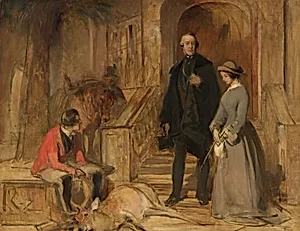
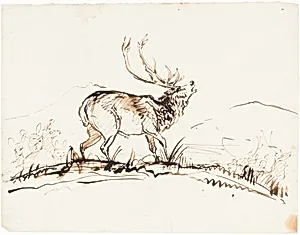
Landseer worked in the Animalier tradition, becoming Victorian Britain’s preeminent painter of animals—especially horses, dogs, and stags—often endowing them with anthropomorphic emotions and narrative drama that resonated across social classes. Elected an Associate of the Royal Academy at the minimum age of 24 and a full Academician in 1831, he was knighted by Queen Victoria in 1850. After first visiting Scotland in 1824, he produced many of his most celebrated Highland scenes, including The Hunting of Chevy Chase (1825–26) and The Illicit Highland Whisky Still (1826–29). He also painted portraits of the queen, Prince Albert, their children, and royal pets, and taught the couple to etch.
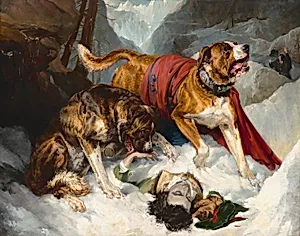
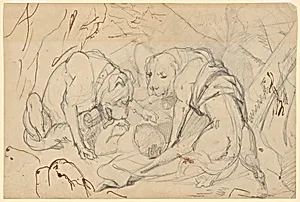
His major works include the iconic stag portrait The Monarch of the Glen (1851), Alpine Mastiffs Reanimating a Distressed Traveller (1820), A Distinguished Member of the Humane Society (1838), Saved (1856), and the satirical Laying Down the Law (c. 1840). As a sculptor he created the four bronze lions at the base of Nelson’s Column in Trafalgar Square, installed in 1867. Later paintings such as Man Proposes, God Disposes (1864) took on a more pessimistic tone. Much of his fame and income came from widely circulated engravings, many executed by his brother Thomas Landseer.
In his later years Landseer suffered recurring melancholy and was declared insane in 1872 at his family’s request. He died on 1 October 1873 and received a national funeral, with flags at half-mast and wreaths placed on his Trafalgar Square lions; he was buried in St Paul’s Cathedral. His anthropomorphic animal pictures popularized the black-and-white Landseer Newfoundland dog and remain landmarks of Victorian visual culture, admired for their anatomical precision, emotional storytelling, and technical brilliance. Unfinished canvases left in his studio were completed by his friend John Everett Millais according to Landseer’s dying wish.