
Ctrl K
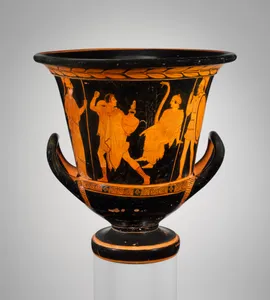
**The Spreckles Painter** was an anonymous Attic vase-painter active in Athens during the Classical period of ancient Greece, around 450 BCE. Like most Greek ceramic artists of the era, his personal biography remains unknown; no records survive of his birth, training, or family. Scholars identify him today solely through stylistic analysis of surviving pottery, a common practice for unnamed ancient craftsmen whose works were signed only rarely.
He worked in the red-figure technique, which had become dominant in Attic pottery by the mid-fifth century BCE. This method allowed painters to render figures with greater anatomical detail and expressive poses against the reserved clay background. The Spreckles Painter’s output aligns with the refined, narrative-driven style of the period, often associated with the broader Niobid Group of vase-painters who favored mythological scenes with multiple figures and architectural elements.
His only securely attributed work is a terracotta calyx-krater (mixing bowl) now in the Metropolitan Museum of Art (acc. no. 07.286.66). Dated circa 450 BCE, the vase depicts on its obverse the myth of Kadmos slaying the serpent guarding the spring at Thebes, assisted by Athena, with Ares and a seated nymph or personification of Thebes also present. The reverse shows a quieter scene of a man standing between two women. The composition demonstrates the painter’s skill in arranging dynamic figures within the curved surface of the krater while clearly conveying the dramatic narrative.
Although little else is known of his career, the Spreckles Painter’s contribution lies in preserving vivid illustrations of Greek mythology that continue to inform modern understanding of ancient storytelling and religious belief. His single surviving masterpiece stands as a fine example of mid-fifth-century Attic red-figure pottery at its narrative peak.
All 1 artworks loaded