
Ctrl K
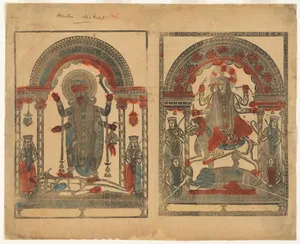
Sri Hemchandra Das was a prominent patua (scroll painter) active in the vibrant Kalighat painting tradition of 19th-century Calcutta (present-day Kolkata), West Bengal. Little is known about his early life, which remains sparsely documented, but his emergence aligns with the peak of Kalighat art in the 1890s. These paintings, produced by itinerant artists near the Kali Temple in Kalighat, captured the pulse of colonial Bengal through bold, satirical depictions of everyday life, mythology, and social commentary. Das contributed to this democratized folk art form, which flourished as affordable souvenirs for pilgrims and urbanites, blending indigenous patachitra techniques with subtle Western influences like shading and perspective introduced via print media.
Working in the Kalighat school tradition, Das mastered the hallmark style: vibrant watercolors on handmade paper or mill-made sheets, featuring simplified forms, expressive lines, and vivid primary colors. His compositions often centered Hindu deities and narratives, rendered with a naive yet incisive aesthetic that critiqued social hypocrisies—such as babus (clerks), prostitutes, and pseudo-saints—while revering divine figures. Unlike courtly miniatures, Kalighat works were mass-produced for quick sale, reflecting the patuas' entrepreneurial spirit amid British rule.
Among Das's known works is *The Goddesses Kali and Jagadhatri*, a striking pat from around the 1890s, now in the collection of The Metropolitan Museum of Art in New York. This piece exemplifies his skill in portraying fierce mother goddesses—Kali, the destroyer of evil, and Jagadhatri, the world-protector—in dynamic poses amid attendants and symbolic motifs, showcasing the devotional intensity of Kalighat iconography. Provenance traces it from a private Calcutta collection to its donation to the Met in 2021.
Das's legacy endures as a testament to the resilience of vernacular Indian art during colonial transition. His contributions helped preserve the patua lineage, influencing later Bengal School revivalists like Jamini Roy, who drew from folk roots. Today, Das's work in major museums underscores Kalighat painting's role in bridging folk tradition and modern collecting, offering insights into Bengal's cultural ferment. (312 words)