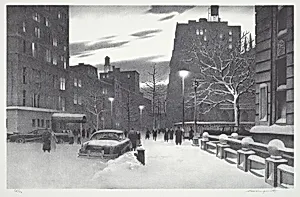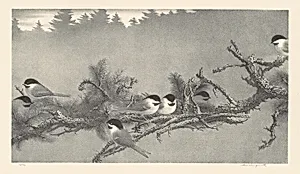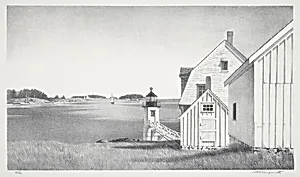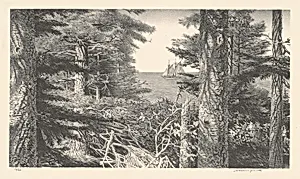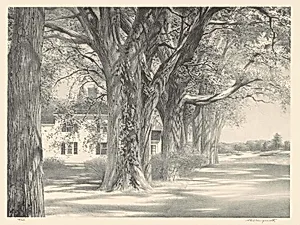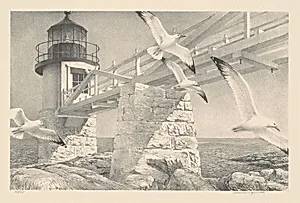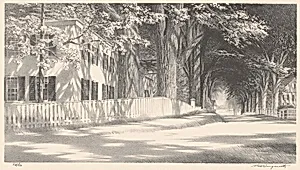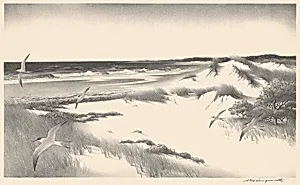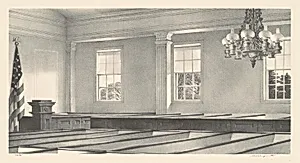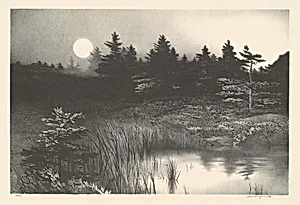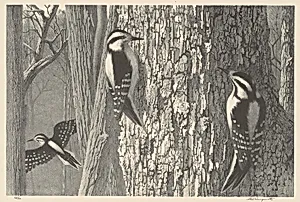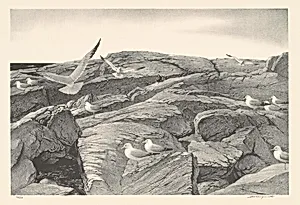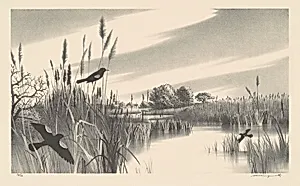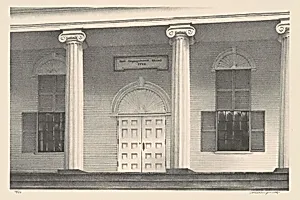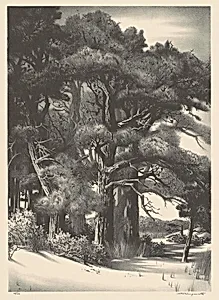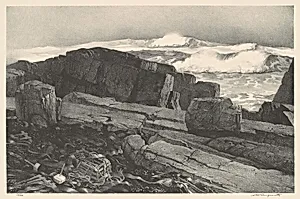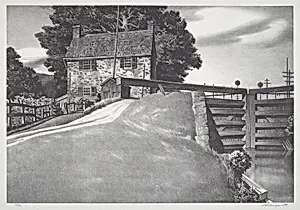
Stow Wengenroth (1906–1978) was an American lithographer celebrated for his meticulously detailed prints of New England coastal towns, lighthouses, harbors, and rural landscapes. Born in Brooklyn, New York, he studied at the Art Students League under George Bridgman and Wayman Adams, and later with the printmaker George Miller, who taught him the techniques of lithography that would become his primary medium.
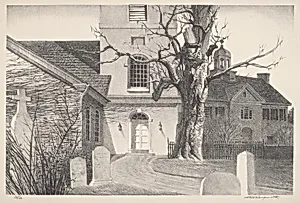
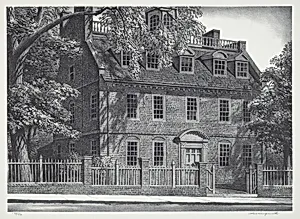
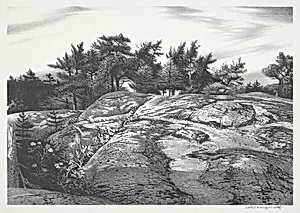
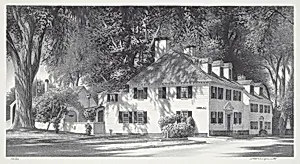
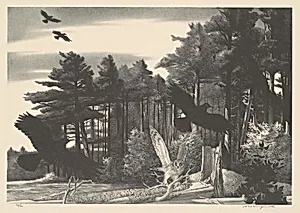
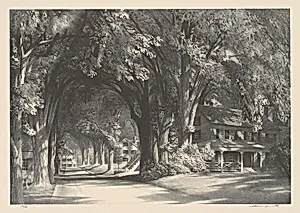
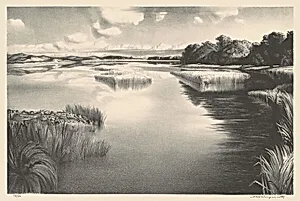
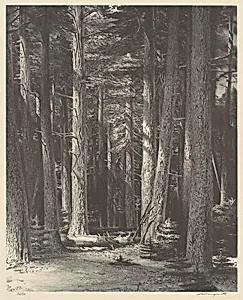
Wengenroth devoted his career almost exclusively to lithography, producing richly toned prints that capture the character of small-town New England — weathered clapboard houses, rocky shores, fishing boats, church steeples, and the play of light and shadow across harbors and hillsides. Working from detailed pencil drawings made on location, he transferred his compositions to lithographic stone with extraordinary precision, building up complex tonal effects through multiple passes.
His prints are distinguished by their luminous skies, crisp architectural detail, and a profound sensitivity to the mood and atmosphere of the New England coast, particularly Maine, where he spent many summers working. Wengenroth's technical mastery of lithography was widely admired, and his prints achieve a tonal richness and depth of field that rival photographs while retaining the distinctive warmth of hand-drawn imagery.
Wengenroth received numerous awards throughout his career, including prizes from the National Academy of Design and the Society of American Graphic Artists. He was elected to the National Academy and was a member of numerous printmaking societies. His lithographs are held by the Metropolitan Museum of Art, the Smithsonian American Art Museum, the Library of Congress, and the Portland Museum of Art.