
Ctrl K
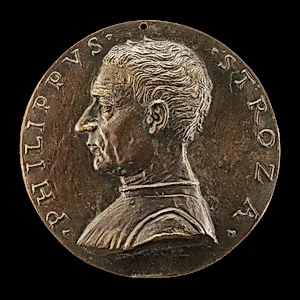
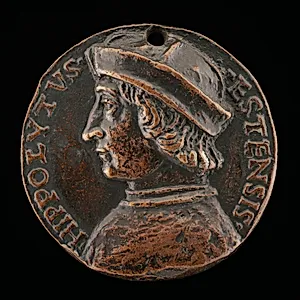
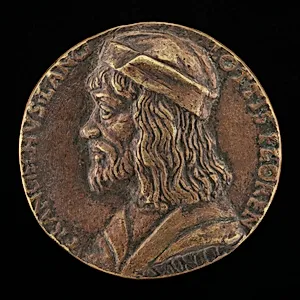
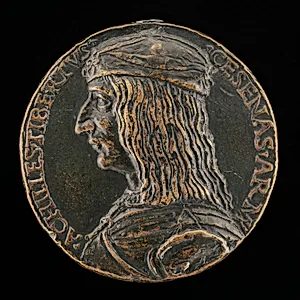
"Style of Niccolò Fiorentino" refers to the distinctive manner of bronze portrait medals produced by the workshop, circle, or close followers of the Florentine medallist Niccolò di Forzore Spinelli (1430–1514), known as Niccolò Fiorentino. Born into a prominent family of Florentine goldsmiths, Spinelli—great-nephew of the painter Spinello Aretino—emerged as one of the leading figures in the burgeoning art of Renaissance portrait medals. His career is traced through documents, including his work as a seal-engraver for Charles the Bold, Duke of Burgundy, in 1468, a marriage in 1471, and a guild commission in Florence in 1484; he fathered at least six children and was buried in Santa Maria Novella. Active primarily in Florence from around 1480 to 1510, he occasionally traveled to Flanders and the Burgundian court, influencing and drawing from northern European traditions.
Little is documented about Spinelli's formal training, though his goldsmith heritage provided a natural foundation in metalworking and engraving techniques; he favored the labor-intensive lost-wax casting method over emerging minting processes. Works in the "Style of Niccolò Fiorentino" capture his hallmark high-relief portraits—bolder in scale, more varied in pose, and bluntly realistic in facial features—rooted in the Florentine Quattrocento tradition of individualized likenesses. Only five medals bear his signature, including those of Bishop Silvestro Daziari (1485), Alfonso I d'Este (1492), Antonio Geraldini, A. della Lecia, and Lorenzo de' Medici "il Magnifico," but over 150 others, like portraits of Marsilio Ficino, Girolamo Savonarola, Caterina Sforza, and Giovanni Tornabuoni, are attributed to his manner.
These medals served as Renaissance "calling cards," blending classical revival with contemporary portraiture to commemorate scholars, rulers, and statesmen. Fiorentino's innovations in realism and depth elevated the genre, spawning a prolific school whose anonymous outputs—exemplified by dozens in museum collections—perpetuate his legacy into the 16th century. Today, virtual museums highlight upwards of 57 such works, underscoring the enduring appeal of this vivid window into late 15th-century Florentine society.
![Michelangelo di Guglielmino Tanaglia, 1437-1512 [obverse]](https://images.artheonmuseum.org/nga/thumb/michelangelo-di-guglielmino-tanaglia-1437-1512-nga-44860.webp)
![Youth Wearing an Animal's Skin [reverse]](https://images.artheonmuseum.org/nga/thumb/youth-wearing-an-animals-skin-reverse-nga-44861.webp)
![Gianozzo di Bernardo Salviati, born 1462 [obverse]](https://images.artheonmuseum.org/nga/thumb/gianozzo-di-bernardo-salviati-born-1462-obverse-nga-44858.webp)
![Fortune with Sail, on a Dolphin [reverse]](https://images.artheonmuseum.org/nga/thumb/fortune-with-sail-on-a-dolphin-reverse-nga-44859.webp)
![Marsilio Ficino, 1433-1499, Florentine Humanist [obverse]](https://images.artheonmuseum.org/nga/thumb/marsilio-ficino-1433-1499-florentine-humanist-nga-44811.webp)
![Inscription [reverse]](https://images.artheonmuseum.org/nga/thumb/inscription-reverse-nga-44812.webp)
![Ottaviano on Horseback [reverse]](https://images.artheonmuseum.org/nga/thumb/ottaviano-on-horseback-reverse-nga-44843.webp)
![Alessandro di Gino Vecchietti, 1472-1532 [obverse]](https://images.artheonmuseum.org/nga/thumb/alessandro-di-gino-vecchietti-1472-1532-obverse-nga-44853.webp)
![Fortune Riding on a Dolphin [reverse]](https://images.artheonmuseum.org/nga/thumb/fortune-riding-on-a-dolphin-reverse-nga-44854.webp)
![Ottaviano Sforza Riario, b. 1479, Count of Forli and Imola [obverse]](https://images.artheonmuseum.org/nga/thumb/ottaviano-sforza-riario-b-1479-count-of-forli-and-nga-44842.webp)
![Girolamo Savonarola, 1452-1498, Dominican Preacher [obverse]](https://images.artheonmuseum.org/nga/thumb/girolamo-savonarola-1452-1498-dominican-preacher-nga-44838.webp)
![Map of Italy Threatened by a Dagger [reverse]](https://images.artheonmuseum.org/nga/thumb/map-of-italy-threatened-by-a-dagger-reverse-nga-44839.webp)
![Fra Alberto Belli, died 1482 [obverse]](https://images.artheonmuseum.org/nga/thumb/fra-alberto-belli-died-1482-obverse-nga-44806.webp)
![Standing Figure of Faith [reverse]](https://images.artheonmuseum.org/nga/thumb/standing-figure-of-faith-reverse-nga-44807.webp)
![Roberto di Ruggiero Macinghi [obverse]](https://images.artheonmuseum.org/nga/thumb/roberto-di-ruggiero-macinghi-obverse-nga-44815.webp)
![Ruberto di Bernardo Nasi, born 1479, Prior of Liberty 1513 [obverse]](https://images.artheonmuseum.org/nga/thumb/ruberto-di-bernardo-nasi-born-1479-prior-of-nga-44820.webp)
![Virginity Tying Love to a Tree [reverse]](https://images.artheonmuseum.org/nga/thumb/virginity-tying-love-to-a-tree-reverse-nga-44821.webp)
![Vigilance [reverse]](https://images.artheonmuseum.org/nga/thumb/vigilance-reverse-nga-44816.webp)
![Ercole I d'Este, 1431-1505, Duke of Ferrara, Modena, and Reggio 1471 [obverse]](https://images.artheonmuseum.org/nga/thumb/ercole-i-deste-1431-1505-duke-of-ferrara-modena-nga-44809.webp)
![Maria Poliziana [reverse]](https://images.artheonmuseum.org/nga/thumb/maria-poliziana-reverse-nga-44833.webp)
![Minerva Resting on a Spear and Shield [reverse]](https://images.artheonmuseum.org/nga/thumb/minerva-resting-on-a-spear-and-shield-reverse-nga-44810.webp)