Ctrl K
1569–1622
**Frans Pourbus the Younger (1569–1622)** was a Flemish painter renowned for his court portraits, continuing a distinguished family tradition as the third generation of prominent religious and portrait artists. Born in Antwerp around September to November 1569, he was the son of Frans Pourbus the Elder (1545–1581) and Suzanna Floris, whose own family connections linked back to leading Antwerp painters like Frans Floris. His grandfather, Pieter Pourbus, had been the preeminent portrait and history painter in Bruges during the mid-to-late sixteenth century.
Early records of his training are absent, but he likely apprenticed in his grandfather’s workshop before gaining admission as a master in Antwerp’s Guild of St. Luke in the 1591–92 guild year. His career quickly moved into high-level patronage. He first served the Archdukes Albert and Isabella in Brussels, producing portraits such as one of the Infanta presented to the English court. In 1600, Vincenzo Gonzaga, Duke of Mantua, recruited him as court painter; Pourbus worked there until 1609, overlapping with Peter Paul Rubens but without recorded conflict. He then relocated to Paris at the invitation of Marie de’ Medici, serving as her court painter and becoming naturalized French in 1617.
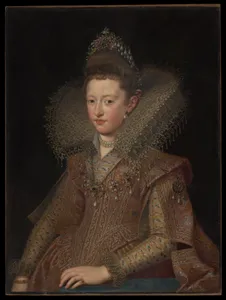
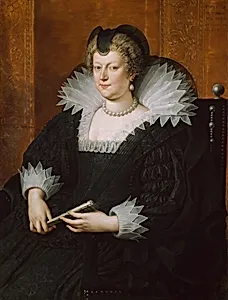
Pourbus specialized in formal, full-length royal and aristocratic portraits that emphasized costume, jewelry, and rich draperies over dramatic narrative or landscape settings. His style was polished and flattering to patrons, yielding works such as *Portrait of Eleonora de’ Medici Gonzaga* (c. 1600–1602), portraits of Louis XIII, Henry IV of France, Anne of Austria, and multiple depictions of Marie de’ Medici herself. He also produced occasional altarpieces, including *St Francis of Assisi receiving the stigmata*. His paintings appear today in major collections including the Louvre, Prado, Royal Collection, Rijksmuseum, and Metropolitan Museum of Art.
Pourbus died in Paris and was buried on 19 February 1622. As one of the principal court portraitists of his era, he bridged Flemish traditions with the demands of European royalty, influencing the representation of power and status in early seventeenth-century art. His meticulous attention to surface detail and dignified composure helped define the visual language of absolutist courts from Brussels to Mantua and Versailles.