Ctrl K
Thomas Flavell (1906–1975) was born in Cynwyd, Pennsylvania, and developed his artistic talents in the vibrant cultural milieu of Philadelphia. He studied at the prestigious Pennsylvania Academy of the Fine Arts (PAFA), where he trained under the guidance of Grace Thorp Gemberling, honing his skills in drawing and painting. This rigorous education equipped him with a modernist sensibility, emphasizing precise observation and abstracted forms, which became hallmarks of his oeuvre.
Flavell's career flourished during the Great Depression as a key participant in Pennsylvania's Works Progress Administration (WPA) Federal Art Project, one of the New Deal's most ambitious cultural initiatives that employed thousands of artists nationwide. He gained recognition for his evocative depictions of buildings in old Philadelphia neighborhoods—row houses, stations, and urban vignettes rendered in pastel and oil with a modernist touch that balanced realism and geometric simplification. His works captured the textured patina of everyday architecture, reflecting both nostalgia for vanishing cityscapes and the era's social realism. Flavell exhibited regularly at PAFA in 1934, 1938, and 1944; the Metropolitan Museum of Art in 1945 and 1946; Woodmere Art Gallery; Philadelphia Sketch Club; Cheltenham Art Center; and Germantown Art League in 1937. He was a fellow of PAFA and a member of Woodmere Art Gallery.
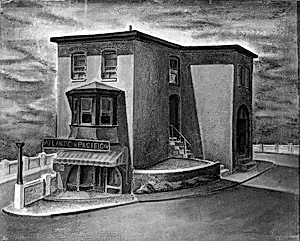
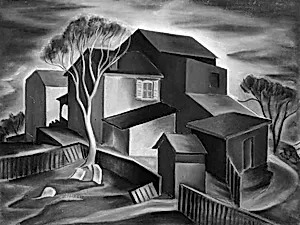
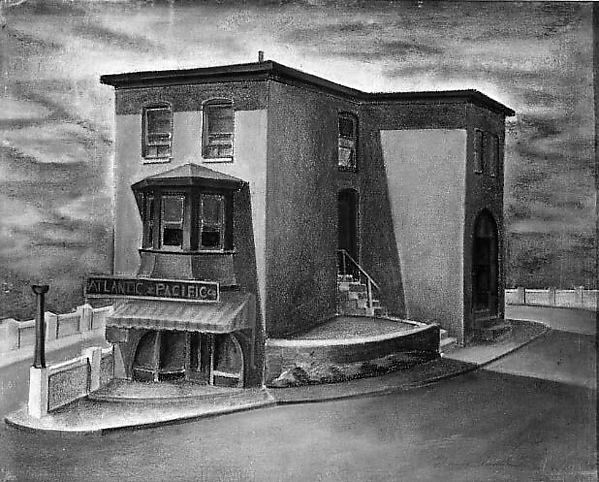
Among his notable works are *Composition of a House* (ca. 1936, pastel on tracing paper) and *Atlantic and Pacific* (ca. 1940, pastel on paper), both gifted to the Metropolitan Museum of Art through the Pennsylvania WPA. Another version, *Composition of a House* (ca. 1940), resides in the Palmer Museum of Art. His paintings also appear in prestigious collections including the Smithsonian American Art Museum, Philadelphia Museum of Art, Pennsylvania State Museum in Harrisburg, Wilmington Society of Fine Arts, the White House, and the U.S. General Services Administration, which holds five of his New Deal-era pieces.
Though not a household name, Flavell's legacy endures through his contributions to American regional modernism and the WPA's democratization of art. His sensitive portrayals of Philadelphia's architectural soul preserve a slice of mid-20th-century urban America, reminding us of the era's artistic resilience amid economic hardship. Today, his works continue to resonate in public collections, offering quiet testament to the power of place-based modernism.
Wikidata (CC0)
All 2 artworks loaded