
Ctrl K
1786–1824
Thomas Kinney was an American silversmith born in 1786 who worked in Norwich, Connecticut, until his death in 1824. Norwich was a prosperous New England port whose craftsmen supplied silver for local households and trade. Details of Kinney’s early life and training remain unrecorded, a common gap for many regional artisans of the Federal era who learned their trade through family workshops or informal apprenticeships rather than formal academies.
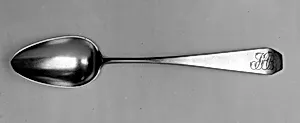
He produced coin-silver tableware in the restrained Federal style typical of early-nineteenth-century New England, favoring practical forms such as spoons with downturned fiddle handles and small salts. His mark, the initials TK, appears on pieces dated around 1807–1810. A representative example is the silver spoon of circa 1810 now in the Metropolitan Museum of Art, made in Norwich and measuring just over nine inches. Other surviving works include teaspoons and a pair of salts from the same period, objects that combined everyday utility with the clean lines and balanced proportions valued in post-Revolutionary American silver.
Kinney belonged to a family of craftsmen; his son Thomas Kinne Jr., born in 1808, also became a silversmith and later worked in Cortland, New York, and Joliet, Illinois. This continuation of the trade reflects the typical pattern of skill transmission among American silversmiths, even though no specific teacher for the elder Kinney has been identified. His output, though modest in quantity, belongs to the broader tradition of Connecticut coin silver that served growing middle-class households in the young republic.
Today Kinney’s marked pieces are valued by collectors and museums as documents of regional craftsmanship. They illustrate how American silversmiths adapted European forms to local tastes and materials in the decades after independence, leaving a small but tangible record of Norwich’s contribution to the decorative arts.