Ctrl K
Thomas-Victor Sergent (1834–1890) was a French ceramicist whose career exemplifies the 19th-century revival of Renaissance enameling techniques. Born on July 27, 1834, in Iffendic, Brittany, Sergent began as a career soldier but pivoted dramatically to ceramics after befriending the Barbizet family and marrying one of Victor Barbizet's daughters. He studied under his father-in-law, Victor Barbizet, a leading Parisian artisan renowned for Palissy-inspired earthenware featuring naturalistic motifs like fish and shells. This familial and professional bond immersed Sergent in the neo-Palisséens movement, particularly its Paris school, which emulated Bernard Palissy's rustic, enamel-glazed pottery with vivid colors and molded reliefs of flora and fauna.
In 1876, Sergent established his workshop at 106 Avenue d'Orléans in Montrouge, south of Paris, where he produced ceramics for about a decade. His early pieces mirrored Barbizet's simpler platters but evolved into a distinctive style marked by highly plastic barbotine clay, deep glazes with jasper-like marbling in blues and browns, and luminous, contrasting hues softer than his peers' yet more vivid. Sergent's vigorous bestiary—lobsters, shells, snakes, and mythical figures—stood out for its expressive modeling, blending realism with stylized forms that foreshadowed Art Nouveau and even surrealism. He exhibited internationally, earning a bronze medal at the 1878 Paris Universal Exhibition, alongside showings in Vienna (1873), London (1874), and Amsterdam (1883).
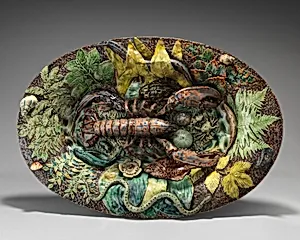
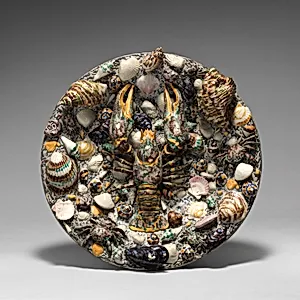
Sergent's oeuvre includes masterful glazed earthenware like the *Oval Platter with Lobster* (1870–80) and *Round Dish with Lobster and Shells* (ca. 1870–80), both in The Metropolitan Museum of Art, where encrusted mollusks and camouflaged crustaceans create dynamic, trompe-l'œil surfaces. Other works feature horse-head vases, female figures, and Palissy-style chargers with seafood, often signed "TS" or "Th. Sergent."
As one of the Paris school's key figures alongside Barbizet and Georges Pull, Sergent helped sustain Palissy's legacy amid industrial-era tastes, producing prolifically until his death in 1890. His technically masterful, nature-infused ceramics remain prized in museums and auctions, bridging Renaissance rusticity with modern decorative innovation.
All 2 artworks loaded