
Ctrl K
1786–1806
Toussaint-François Pillieux was a French goldsmith active in Paris during the late eighteenth and early nineteenth centuries. He achieved master status in March 1786 and continued working at least until 1806, with some pieces dated as late as 1809–1813. His output centered on luxury personal items such as étuis, snuff boxes, and needle cases, executed in gold with enamel, verre-églomisé, and chased or engine-turned decoration typical of the Louis XVI and early Empire periods.
Early life details remain undocumented. As a master craftsman in the Parisian guild system, Pillieux would have completed an apprenticeship and presented a masterpiece to gain his title, yet no records identify a specific teacher or workshop affiliation. His surviving works demonstrate technical mastery of goldsmithing techniques, including translucent enamels over machine-turned grounds and delicate foliate borders.
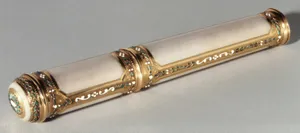
Among his documented pieces is an elegant gold and enamel étui dated 1785–86, now in the Metropolitan Museum of Art collection; it features opalescent enamel over a sunken engine-turned body. Other examples include a circular vari-coloured gold snuff box of 1787, a Louis XVI verre-églomisé and gold snuff box of 1789, and an oval gold box marked for 1806–1809. These objects reflect the refined taste of Parisian luxury goods during the transition from the ancien régime through the Revolutionary and Napoleonic eras.
Pillieux’s legacy rests on the survival of his finely crafted objects in museum holdings and private collections. His work exemplifies the high standards of French goldsmithing at the close of the eighteenth century and continues to appear at auction, valued for its precision and period elegance.
No artworks found for this artist