Ctrl K
The Urbino Potteries encompass the celebrated cluster of ceramic workshops, or botteghe, that flourished in the hill town of Urbino in Italy’s Marche region during the Renaissance. Simple earthenwares had been made locally since the fifteenth century, but from about 1520 the industry, actively encouraged by the Della Rovere dukes Francesco Maria I and Guidobaldo II, came to dominate the luxury market for tin-glazed pottery known as maiolica. Local clay deposits supplied the kilns, and the finished wares were exported throughout Italy and beyond, establishing Urbino—together with nearby Castel Durante and Gubbio—as a leading center of ceramic production in the duchy.
These workshops became famous for the istoriato style, in which a single vivid narrative scene drawn from the Bible, classical mythology, ancient history, or contemporary poetry covers the entire surface of a plate or dish. Brilliant yellows, oranges, and browns predominate, creating an illusionistic pictorial effect inspired by contemporary painting and by printed engravings. Nicola da Urbino (ca. 1480–1540/1547), who had worked earlier at Castel Durante, introduced and perfected this approach after settling in Urbino around 1528; he painted in the workshop of his son Guido Fontana and freely adapted woodcuts from Ovid’s Metamorphoses as well as compositions after Raphael. Francesco Xanto Avelli was another distinguished painter active in the city, while later generations of the Fontana family, including Orazio Fontana, shifted toward the lighter grottesche style of arabesques and motifs derived from Raphael’s Vatican decorations around 1560–70.
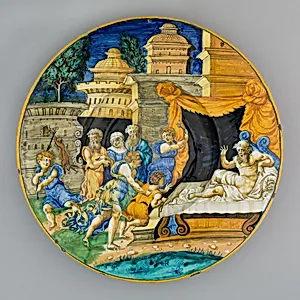
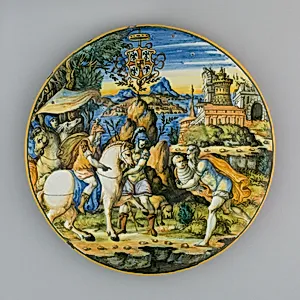
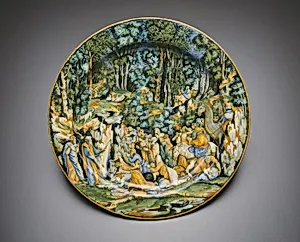
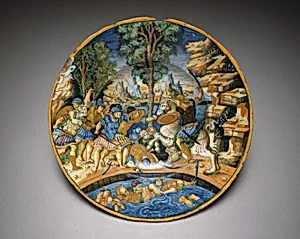
Four characteristic plates from these potteries survive in the Art Institute of Chicago. They include the Plate with Horatio at the Bridge (c. 1535), inscribed with a Latin reference to the Roman hero defending the city; the Plate with Isaac Blessing Jacob (1540/1545), produced in the workshop of Guido di Merlino and inscribed “benedicione de jacob”; the Plate with Moses Striking the Rock (c. 1545); and the Plate with the Story of Numa Pompilius and Arms of Gonzaga (c. 1560) from the Fontana Workshops. These works illustrate the narrative sophistication and technical brilliance that made Urbino maiolica prized by Renaissance courts.
Although production declined in the late seventeenth century, the Urbino potteries left an enduring legacy. Their istoriato wares set a standard of artistic ambition for European ceramics, and the tradition of tin-glazed earthenware continues in the city today. The surviving pieces remain treasured documents of Renaissance humanism, technical mastery, and courtly patronage.