Ctrl K
Ursula Schulz-Dornburg (b. 1938) is a German photographer and conceptual artist whose spare, methodical images of landscape, infrastructure, and architecture have established her as one of the most distinctive voices in European documentary photography. Born in Berlin, she studied ethnology at the University of Munich beginning in 1958 before transferring to study photojournalism at the Institut für Bildjournalismus in Munich, where she remained until its closure in 1960 following the death of its founder, Hans Schreiner. A period spent in New York in 1967 proved decisive: there she encountered land art and conceptual art, movements whose influence would shape the austere, system-driven approach she brought to photography throughout her subsequent career.
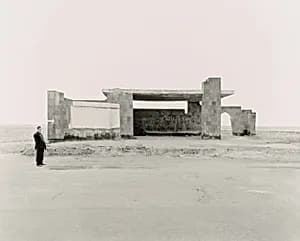
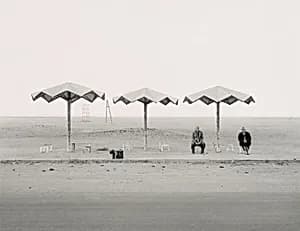
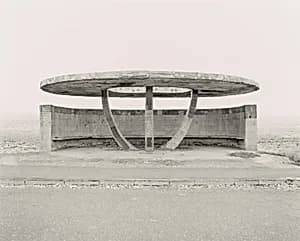
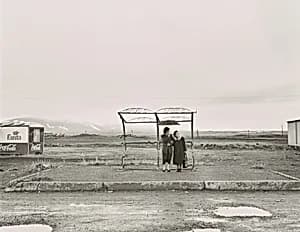
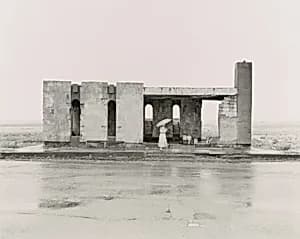
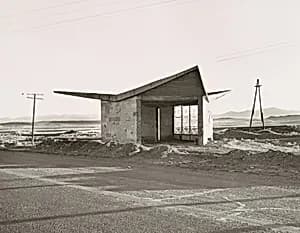
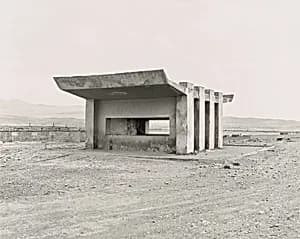
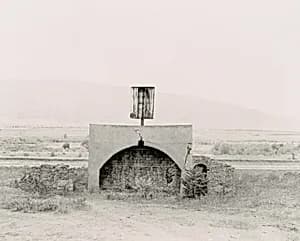
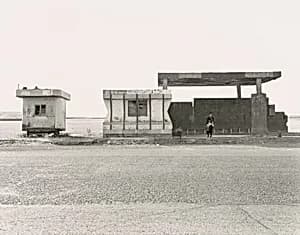
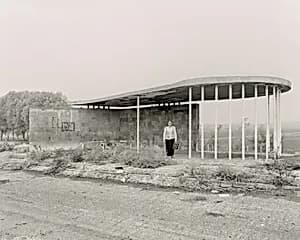
Schulz-Dornburg is best known for sustained photographic series organized around specific sites, routes, or architectural typologies in Europe, the Caucasus, and the Middle East. Her series Bus Stops in Armenia documents transit shelters scattered across the Armenian landscape — structures that combine Soviet-era monumentality with local craft, often set against desolate terrain. Each photograph in the series is identified by the departure and arrival points of the bus route it serves, imposing a spare documentary logic on subjects of striking formal and cultural richness. Her series Sonnenstand, which records the movement of light across ancient solar-oriented sites, was acquired in its entirety by the Corcoran Gallery of Art and exhibited there and at the Art Institute of Chicago in 1996. She had her first major retrospective, titled "Across the Territories," at the Institut Valencià d'Art Modern (IVAM) in 2002.
Working within a minimalist aesthetic that owes something to the Düsseldorf School of Photography while maintaining its own quieter register, Schulz-Dornburg approaches her subjects with patient attention and disciplined restraint. Her photographs accumulate meaning through seriality and repetition rather than dramatic singular image-making. Her work is held in the collections of the Tate, the National Gallery of Art, and other major institutions, and has attracted renewed international attention for its prescient treatment of borders, transit, memory, and the traces left by political systems on built environments.