
Ctrl K
1861–1927
Occupations
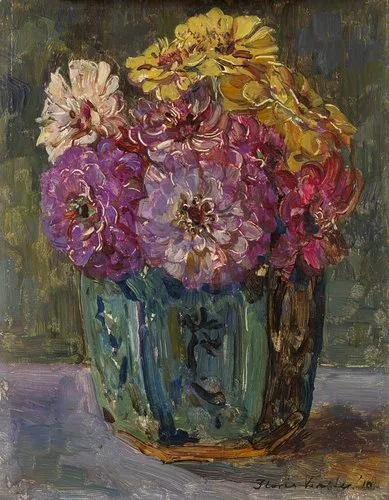
Floris Hendrik Verster (1861-1927) was a Dutch painter celebrated as the great innovator of the flower still life in Dutch art history. Born into an artistic family in Leiden, Verster transformed the traditional Dutch still life genre through his passionate use of color and rough, expressive brushwork that departed dramatically from the subdued tonalities of the contemporary Hague School. His career traced a remarkable evolution from academic training through avant-garde experimentation to a final period of serene contemplation. Verster's artistic development was shaped by encounters with international modernism, particularly through his association with Les Vingt, the progressive Belgian artists' group, and his friendship with Jan Toorop. These influences led him to work with intense colors and energetic brushstrokes that anticipated Expressionism. Between 1892 and 1900, his work underwent a profound metamorphosis as he devoted himself almost entirely to drawings in crayons, creating serene compositions that contrasted sharply with his earlier intensity. This stylistic diversity makes Verster a complex figure whose work resists easy categorization.
Floris Hendrik Verster was born on June 9, 1861, in Leiden, Netherlands, into a family with strong artistic and scientific traditions. His father, Abraham Florentius Verster van Wulverhorst, served as administrator of the National Museum of Natural History in Leiden and was himself a renowned scholar and accomplished painter specializing in bird studies.
Growing up surrounded by both scientific observation and artistic practice, Verster developed a keen eye for natural detail combined with aesthetic sensibility. His father's dual career as scientist and artist may have influenced Verster's own approach to still life painting, which combined meticulous observation with expressive interpretation.
Between 1880 and 1884, Verster continued his artistic education at the Royal Academy of Art in The Hague, then the center of Dutch artistic life. His fellow students included future luminaries of Dutch art: George Hendrik Breitner, Isaac Israëls, and Willem de Zwart, all of whom would become associated with the Amsterdam Impressionism movement.
As a colorist, Verster excelled from his earliest mature works, but his passionate color vision differed markedly from the prevailing Hague School style. The Hague School, which dominated Dutch painting in the late nineteenth century, favored subdued gray and brown tonalities inspired by seventeenth-century Dutch masters and French Barbizon painting.
Verster's rejection of Hague School restraint became more pronounced following his encounters with international avant-garde movements. In Brussels, he met Jan Toorop, a Dutch-Indonesian painter who would become one of the leading figures in Symbolism and Art Nouveau, and other members of Les Vingt, the progressive Belgian artists' group that championed Post-Impressionism and Symbolism.
Partly under the influence of Les Vingt, Verster began working with rough brushstrokes and intense colors that set his work apart from contemporary Dutch painting. His flower still lifes from this period feature bold, almost violent applications of paint and color combinations that shocked conservative viewers accustomed to more harmonious arrangements.
During these years, Verster established his reputation as the innovator who transformed the Dutch flower still life tradition. Where earlier Dutch still life painters had emphasized illusion and refinement, Verster emphasized paint as material substance and color as expressive force, anticipating developments in twentieth-century modernism.
Between 1892 and 1900, Verster's work underwent a dramatic metamorphosis that surprised those familiar with his earlier intensity. He turned almost entirely to drawings executed in crayons, abandoning the vigorous brushwork and bold colors that had characterized his previous work.
These crayon drawings featured serene subjects rendered with delicate precision—a marked contrast to his earlier passionate still lifes. The shift suggests either a personal spiritual transformation or a deliberate exploration of artistic possibilities at the opposite pole from his established manner.
This period of quiet contemplation produced works of subtle beauty that demonstrated Verster's range as an artist. The crayon drawings revealed his fundamental skills as a draftsman, previously somewhat obscured by the painterly vigor of his oils, and showed his ability to express himself through restraint as effectively as through exuberance.
The motivations for this dramatic stylistic shift remain somewhat mysterious. It may have reflected changing personal circumstances, spiritual development, or simply an artist's desire to explore different expressive possibilities. Whatever the cause, these works represent an essential facet of Verster's complex artistic personality.
In his later years, Verster's work continued to evolve, though he returned to painting after his crayon period. His late still lifes maintained his characteristic intense color while showing greater compositional confidence and painterly sophistication gained through decades of practice.
Verster's work gained increasing recognition during his lifetime, with major Dutch museums acquiring his paintings. The Kröller-Müller Museum and the Stedelijk Museum De Lakenhal in Leiden built substantial collections of his work, recognizing his importance to Dutch art.
Museum De Lakenhal in Leiden, Verster's birthplace, eventually assembled the largest collection of his works, with 160 objects encompassing paintings, drawings, and studies. This collection provides comprehensive documentation of his stylistic evolution and technical experimentation.
Tragically, Floris Verster died on January 21, 1927, following an accidental drowning. He slipped and fell into water, bringing an abrupt end to a career that had already secured his place in Dutch art history as the great innovator of the still life genre and one of the most original colorists of his generation.
Artheon Research Team
Last updated: 2025-11-09
Biography length: ~459 words
Wikidata (CC0); Getty ULAN (ODC-By)
