
Ctrl K
1748–1803
The Veuve Perrin Manufactory was a celebrated faïence factory in Marseille, France, that produced tin-glazed earthenware from 1748 until its closure in 1803. It took its name from Pierrette Candelot (1709–1794), known as the Veuve Perrin, who assumed control after the sudden death of her husband Claude Perrin. Born in Nevers into a family of faience makers, Claude had settled in Marseille in 1733 and directed a modest workshop belonging to Pierre Fabre before dying in 1748, leaving behind a financially strained enterprise. Pierrette, originally from Lyon, transformed it into one of the city’s most successful ceramic operations through shrewd expansion, including land purchases for workshops and a source of specialized sand for glazes.
She formed key artistic partnerships that shaped the factory’s output. From 1760 to 1770 she collaborated with Honoré Savy, a painter and member of Marseille’s Academy of Painting and Sculpture, though the association lessened after 1764 when Savy established his own works. In 1774, at age 75, she entered a new partnership with her son Joseph and the enamel painter Antoine Abellard, grandson of the prominent faiencier Antoine Clérissy. After Pierrette’s death in 1794, Joseph and her daughter Anne continued production until economic pressures of the Revolutionary era forced the factory’s end in 1803.
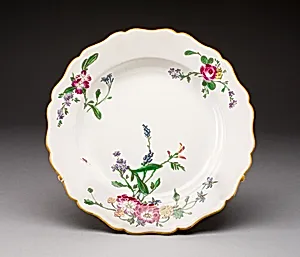
Working in the Marseille school tradition, the manufactory specialized in the petit feu technique of successive low-fire decorations, achieving a vivid polychrome palette that rivaled porcelain. Around 1764 it introduced a distinctive turquoise enamel. Its wares are renowned for naturalistic motifs of flowers, insects, Mediterranean fish and shells (the so-called “bouillabaisse” décor), seaside scenes, and views of Marseille’s port, as well as yellow-ground florals, Chinese-inspired designs, landscapes, and green camaïeu. Rococo forms included elaborate table services, large soup tureens often painted with marine life, potpourri vases, fountains, and ornamental pieces. Notable surviving examples include a pair of potpourri vases of about 1760 now in the Metropolitan Museum of Art.
The Veuve Perrin factory’s technically brilliant and locally inspired ceramics remain among the finest expressions of 18th-century Provençal decorative arts. Works are held in major collections worldwide, including the Louvre, the Musée de la Faïence de Marseille, and the Metropolitan Museum, ensuring its enduring reputation for creativity, color, and craftsmanship.