Ctrl K
1590–1667
Occupations
Christiaen van Vianen (1598-1671) was a Dutch silversmith and draughtsman who achieved distinction in the revolutionary auricular style pioneered by his father Adam van Vianen. Born into one of seventeenth-century Europe's most accomplished silversmithing families, Christiaen inherited and developed the innovative aesthetic characterized by flowing, organic forms resembling ears, cartilage, and marine creatures. Following his father's death in 1627, he continued the Utrecht workshop before relocating to London in 1630, where he established the largest foreign goldsmith workshop in the city, eventually employing nine Dutch craftsmen. His extraordinary technical skill earned praise from the German art historian Joachim von Sandrart, who considered Christiaen equal to his celebrated father. As a foreigner barred from using English hallmarks, he characteristically signed his pieces, leaving a well-documented body of work including the magnificent Dolphin Basin of 1635. His career bridged Dutch and English silver traditions while advancing the auricular style that influenced decorative arts across Europe.
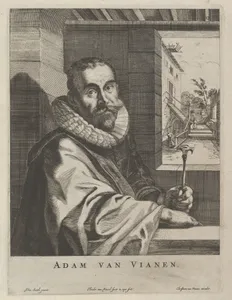
Christiaen van Vianen was born in 1598 in Utrecht, son of Adam van Vianen (c.1568-1627), one of the most innovative silversmiths of the seventeenth century. Adam van Vianen had pioneered the auricular style (kwab in Dutch), a revolutionary aesthetic departing from Renaissance classicism toward fluid, organic forms that seemed to flow and transform like living matter. Growing up in this creative environment, Christiaen absorbed both technical mastery and aesthetic innovation from his father's workshop.
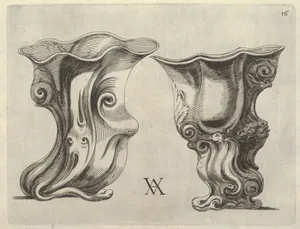
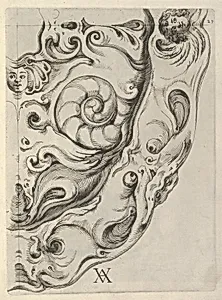
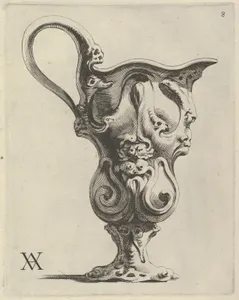
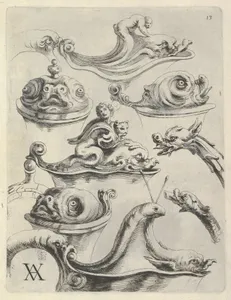
Adam van Vianen's auricular style featured forms resembling ears, cartilage, shells, and marine life, creating works that appeared simultaneously natural and fantastical. The style represented one of the seventeenth century's most original contributions to European decorative arts, influencing not only silver work but also frame-making, sculpture, and architectural ornament.
After Adam van Vianen's death in 1627, Christiaen assumed control of the Utrecht workshop, continuing to work in his father's distinctive style while developing his own interpretations. The German art historian and painter Joachim von Sandrart, who knew both father and son, wrote that Christiaen van Vianen was considered his father's equal in skill—extraordinary praise given Adam's towering reputation.
In 1630, Christiaen made a significant decision: he moved to London and established a workshop in Westminster. This relocation proved highly successful. He quickly built a substantial business, soon employing nine Dutch silversmiths—"the largest alien workshop in London at a time when there were identifiably about 200 foreign goldsmiths, jewellers and engravers working there," according to art historians.
London's cosmopolitan environment and wealthy clientele provided ideal conditions for Christiaen's sophisticated auricular work. However, as a foreigner, he faced an important restriction: English law prohibited non-citizens from hallmarking their pieces with official marks guaranteeing silver content. Consequently, Christiaen regularly signed his works, a practice that has aided subsequent identification and attribution.
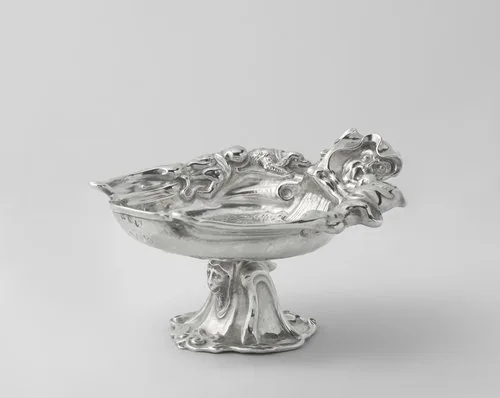
One of his most celebrated works, created in 1635, is a magnificent basin (the matching ewer is now lost) known as the "Silver Dolphin Basin" or "Dolphin Bowl." This remarkable piece, now in the Victoria and Albert Museum in London, exemplifies the auricular style's flowing forms and marine imagery, demonstrating Christiaen's complete mastery of both design and execution.
In 1643, Christiaen returned to Utrecht, possibly bringing the Dolphin Basin with him to the Netherlands. However, his stay proved temporary. He returned to England in 1660, coinciding with the Restoration of Charles II. He continued his successful London practice for another decade until his death in 1671, having spent most of his adult life advancing the auricular style in England.
Artheon Research Team
Last updated: 2025-11-09
Biography length: ~485 words
Wikidata (CC0); Getty ULAN (ODC-By)