
Ctrl K
**Julius Bien (1826–1909)** was a German-born American lithographer who became one of the leading figures in 19th-century American printmaking. Born on September 27, 1826, in Naumburg, Hesse, near Kassel, he trained at the Kunsthochschule in Kassel and continued his studies at the Städel Institute in Frankfurt under the celebrated Jewish artist Moritz Daniel Oppenheim.
After participating in the failed 1848 Revolution, Bien emigrated to New York in 1848 or 1849. He quickly established a lithography studio that grew into the successful firm Julius Bien & Co. Specializing in chromolithography—a technique he had mastered in Germany—his work was noted for its technical excellence and versatility across maps, city views, architectural drawings, and commercial prints.
Bien’s firm produced maps for the U.S. government after the Civil War that achieved new standards of scientific accuracy. His most ambitious project was a full-size chromolithographic edition of John James Audubon’s *The Birds of America*, undertaken in the late 1850s with John Woodhouse Audubon. Using the original copper plates transferred to stone and a limited palette of six colors, Bien completed 150 plates before the project was halted by financial and wartime difficulties in 1860.
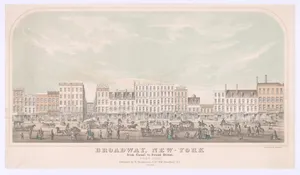
One of his early New York views, *Broadway, New-York from Canal to Grand Street, West Side* (1856), was published by W. Stephenson & Co. Beyond his artistic output, Bien served as president of B’nai B’rith for decades (1854–1857 and 1868–1900) and became the first president of the National Lithographers Association. He died in Manhattan on December 21, 1909, leaving a legacy as a master printer who elevated chromolithography to new artistic and scientific heights in America.