Ctrl K
1779–1843
**Washington Allston** (November 5, 1779 – July 9, 1843) was an American painter and poet who pioneered the Romantic movement in American landscape painting. Born on a rice plantation along the Waccamaw River near Georgetown, South Carolina, he was the son of Captain William Allston, who died shortly after the Battle of Cowpens when Washington was a young child. His mother remarried Dr. Henry C. Flagg, and the family relocated to Newport, Rhode Island. Allston graduated with honors from Harvard College in 1800, where he also distinguished himself as a poet.
After a brief return to Charleston, he sailed for England in 1801 and enrolled at the Royal Academy Schools in London, studying under the president, Benjamin West. He spent the following years traveling through Paris and Italy, where he formed lasting friendships with Washington Irving in Rome and Samuel Taylor Coleridge. In 1809 he married Ann Channing (sister of the Unitarian minister William Ellery Channing); she died in 1815. Allston returned to the United States in 1818 and settled in Cambridge, Massachusetts, for the remainder of his life. He later married Martha Remington Dana in 1830.
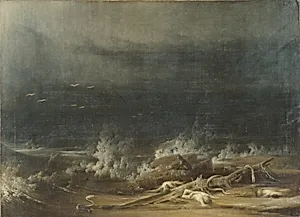
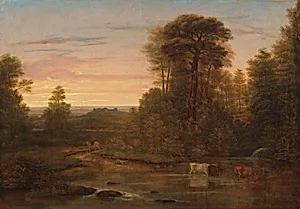
Allston’s artistic style evolved from grandiose depictions of nature’s dramatic spectacles to more subjective, visionary compositions marked by bold contrasts of light, rich atmospheric color, and literary or biblical themes. He earned the nickname “the American Titian” for his Venetian-inspired colorism. Among his notable works are *Elijah in the Desert* (1818), *Moonlit Landscape* (1809), and the ambitious but unfinished *Belshazzar’s Feast* (begun 1817), on which he labored for decades. He also published poetry, including *The Sylphs of the Seasons* (1813), the romance *Monaldi* (1841), and *Lectures on Art* (posthumous, 1850).
Allston’s influence extended far beyond his canvases. He taught or inspired younger artists, including Samuel F. B. Morse and his nephews George Whiting Flagg and Jared Bradley Flagg. His work and ideas shaped American Romanticism and were admired by figures such as Ralph Waldo Emerson, Margaret Fuller, and Henry Wadsworth Longfellow. The Boston neighborhood of Allston and Allston Way in Berkeley, California, bear his name, and he remains celebrated as a foundational figure in the development of American landscape and history painting.
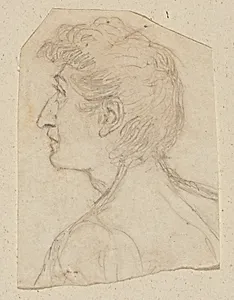
![Composition with Four Figures [recto and verso]](https://images.artheonmuseum.org/nga/thumb/composition-with-four-figures-recto-and-verso-nga-56950.webp)