Wayne Thiebaud, born Morton Wayne Thiebaud on November 15, 1920, in Mesa, Arizona, grew up in a Mormon family in southern California after his parents relocated there shortly after his birth. His father worked various jobs, including as a Ford mechanic and real estate agent. As a teenager, Thiebaud apprenticed one summer at Walt Disney Studios, drawing in-betweens for characters like Goofy and Pinocchio, and studied commercial art at Frank Wiggins Trade School in Los Angeles. He worked as a cartoonist and designer before and during his U.S. Army Air Forces service in World War II. After the war, nearly 30 years old, he pursued fine arts, earning a bachelor's degree in 1951 and a master's in 1952 from Sacramento State College (now California State University, Sacramento), where instructor Robert Mallary encouraged his shift from commercial to fine art.
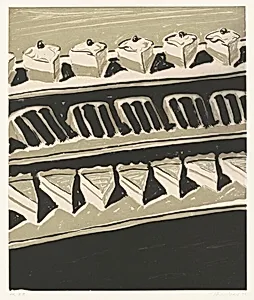
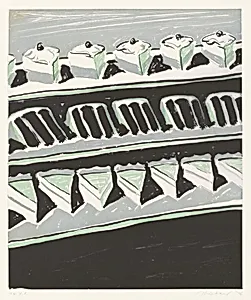
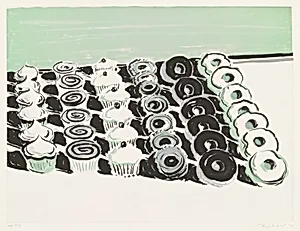
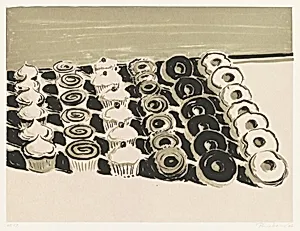
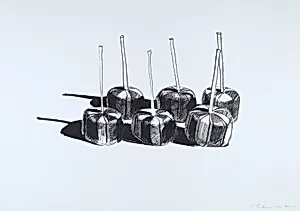
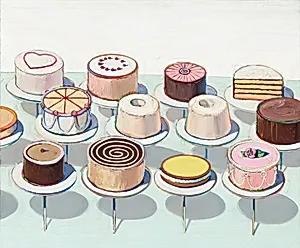
Thiebaud's style drew from his commercial art roots, featuring thickly applied paint, vibrant colors, exaggerated shadows reminiscent of advertisements, and precise lines that blurred fine and commercial art boundaries. Often linked to Pop Art for his everyday subjects like pies, cakes, and ice cream cones, he rejected the label, calling himself an "old-fashioned painter" and emphasizing illusionistic form over mechanical reproduction. In New York during 1956–57, he befriended Willem de Kooning, Franz Kline, Robert Rauschenberg, and Jasper Johns, absorbing Abstract Expressionist energy before returning to California, where Richard Diebenkorn influenced his landscapes. Iconic works include *Cakes* (1963), with its orderly array of frosted treats on pedestals; *Pies* (1961); *Bakery Counter* (1962); and later *Two Paint Cans* (1987) and *Sunset Streets* (1985), blending hyper-realism with skewed perspectives.
Thiebaud taught for decades, chairing the art department at Sacramento City College before joining UC Davis in 1960, where he influenced generations until 2002 as Professor Emeritus. His first solo show came in 1960 at SFMOMA, followed by national acclaim via the 1962 "New Painting of Common Objects" exhibition alongside Warhol and Lichtenstein. Married twice—with daughters Twinka and Mallary from his first marriage to Patricia Patterson, and son Paul (an art dealer who died in 2010) from his second to Betty Jean Carr—Thiebaud painted daily into his 100s.
Thiebaud's legacy endures through retrospectives like the Whitney's in 2001 and his 2021 National Medal of Arts-equivalent honors, celebrating his joyful elevation of consumer culture into tactile, nostalgic masterpieces that evoke abundance and quiet longing. His prints, figures, and vertiginous cityscapes expanded the still-life tradition, inspiring artists to find poetry in the prosaic.

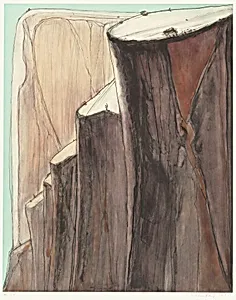
![Canyon Clouds [working proof 1]](https://images.artheonmuseum.org/nga/thumb/canyon-clouds-working-proof-1-nga-230694.webp)
![Canyon Clouds [working proof 2]](https://images.artheonmuseum.org/nga/thumb/canyon-clouds-working-proof-2-nga-230695.webp)
![Canyon Clouds [working proof 3]](https://images.artheonmuseum.org/nga/thumb/canyon-clouds-working-proof-3-nga-230696.webp)
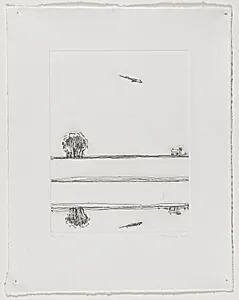
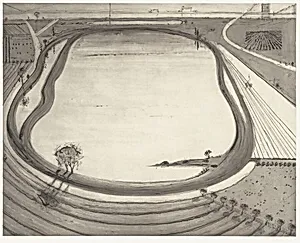
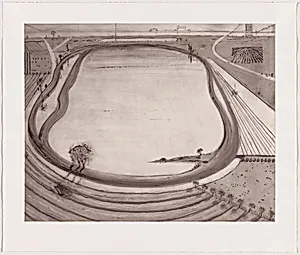
![River and Airplane [working proof 1]](https://images.artheonmuseum.org/nga/thumb/river-and-airplane-working-proof-1-nga-230692.webp)
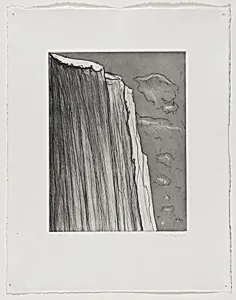
![Canyon Clouds [working proof 4]](https://images.artheonmuseum.org/nga/thumb/canyon-clouds-working-proof-4-nga-230697.webp)
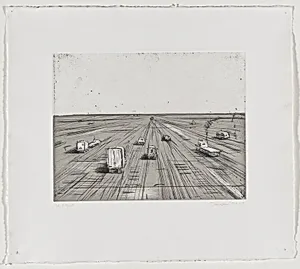
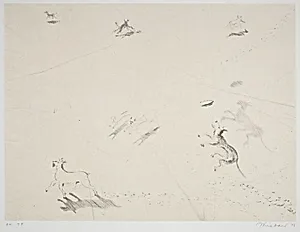
![Travelers [working proof 2]](https://images.artheonmuseum.org/nga/thumb/travelers-working-proof-2-nga-230700.webp)
![Travelers [working proof 3]](https://images.artheonmuseum.org/nga/thumb/travelers-working-proof-3-nga-230701.webp)
![Travelers [preparatory drawing]](https://images.artheonmuseum.org/nga/thumb/travelers-preparatory-drawing-nga-230702.webp)
![Travelers [working proof 1]](https://images.artheonmuseum.org/nga/thumb/travelers-working-proof-1-nga-230699.webp)