
Ctrl K
1607–1677
Wenceslaus Hollar, born Václav Hollar on 13 or 23 July 1607 in Prague, Bohemia, came from a family of minor nobility; his father, Jan Holar, was a lawyer whose fortunes were ruined by the Sack of Prague during the Thirty Years' War. Destined for the law, young Hollar turned to art, producing his earliest known works in 1625–1626, including copies after Albrecht Dürer. He apprenticed under the celebrated engraver Matthäus Merian, first in Prague and later in Frankfurt in 1627, honing his skills in etching and engraving amid travels through Strasbourg, Mainz, Koblenz, and Cologne. In 1636, his talents caught the eye of Thomas Howard, 21st Earl of Arundel, during a diplomatic mission; Arundel employed him as a draftsman, bringing him to England in 1637.
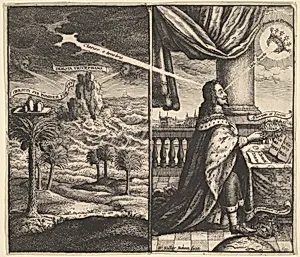
Settling in London, Hollar thrived in Arundel's household, becoming drawing master to the future Charles II around 1639–1640. A prolific Baroque graphic artist, he mastered etching with spirited precision, producing some 2,740 plates and 400 drawings encompassing portraits, topographical views, costumes, still lifes, and book illustrations. His style blended meticulous detail with topographical accuracy, often working to the hourglass for portraits, and he frequently reproduced masters like Dürer or Van Dyck. The English Civil War disrupted his life—he sided with the Royalists, was captured at Basing House in 1644, then fled to Antwerp—but he returned in 1652, later serving Charles II as "His Majesty's designer" and "scenographer."
Hollar's masterpieces capture vanishing worlds: *Ornatus Muliebris Anglicanus* (1640), documenting English women's fashions; the monumental six-plate *Long View of London from Bankside* (1647), a panoramic etching from Southwark Cathedral tower showing the Thames alive with ships and landmarks like Whitehall and the Globe Theatre; portraits of Charles I after Anthony van Dyck (1649); and paired views of London before and after the 1666 Great Fire. He etched Tangier views (1668–1673) and the Battle of Cádiz (1669), plus books like Ogilby's *Virgil* and Dugdale's *Monasticon Anglicanum*. Married twice—first to Tracy, a lady-in-waiting, producing a talented son lost to plague—Hollar died in poverty on 25 March 1677 in London, buried at St. Margaret's, Westminster.
His legacy endures as a vital chronicler of 17th-century Europe, especially pre-fire London, with prints invaluable to historians for architecture, costume, and urban life. Collections worldwide, from the British Museum to Prague's National Gallery, preserve his oeuvre, inspiring modern catalogs and even a Prague art school named for him.