
Ctrl K
1824–1883
**Richard Doyle (1824–1883)** was a leading British illustrator of the Victorian era, renowned for his whimsical depictions of fairies, elves, and fantastical scenes that captured the imaginative spirit of the age. Born in London on 18 September 1824, he was the son of the Irish political caricaturist John Doyle (known as “H.B.”) and grew up in a household of artists; three of his brothers—James, Charles, and Henry—also pursued careers in art. Doyle received no formal training beyond his father’s studio, where he honed his skills from a young age, producing his first complete illustrated book, *Home for the Holidays*, at just twelve (published posthumously in 1887).)
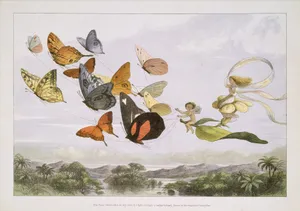
Doyle’s career flourished in the vibrant world of Victorian periodical and book illustration. He contributed extensively to *Punch* magazine, designing its iconic masthead that remained in use for over a century, and became celebrated for his light-hearted, detailed pen-and-ink drawings. His fascination with fairy tales and the supernatural led to some of his most enduring work, most notably the illustrations for William Allingham’s *In Fairyland: A Series of Pictures from the Elf-World* (1870). This lavish volume, with its sixteen color plates of an enchanted realm populated by elves, butterflies, and mythical creatures, was engraved and printed in color by Edmund Evans and published by the firm Longman, Green, Reader, and Dyer. Doyle’s delicate yet lively style blended Pre-Raphaelite attention to natural detail with playful fantasy, helping define the golden age of British children’s book illustration.
Beyond *In Fairyland*, Doyle illustrated numerous other works and contributed to the visual culture of his time through magazine work and standalone prints. His legacy endures in the enduring popularity of his fairy imagery, which influenced later generations of illustrators and helped shape the romantic vision of fairyland in Victorian art and literature. Doyle died in London on 10 December 1883, leaving behind a body of work that continues to delight audiences with its charm and technical brilliance.